


6 minutes

21 October, 2026




Choosing a business name is an exciting step, but before investing in branding, a website or marketing materials, it’s worth checking that the name is available to use.
A name might be available to register with Companies House, but that doesn’t necessarily mean you’re legally entitled to use it. Another business could already hold trade mark rights that prevent you from operating under the same or a similar name.
Fortunately, you can check whether a business name is registered as a trade mark in the UK using the Intellectual Property Office’s (IPO) online database. Here’s how to get started and what to look out for.
How Do I Check if a Business Name Is Trade Marked?
The easiest way to check whether a business name is trade marked in the UK is to search the official UK trade mark register.
The Intellectual Property Office provides a free online search tool that allows you to check existing registrations and applications.
Step 1: Search the UK Trade Mark Register
Visit the UK Intellectual Property Office trade mark search and enter the business name you’re considering.
You can search by keyword, phrase, trade mark number or owner. The database includes registered UK trade marks and applications that are still being processed.
Start by searching for the exact name you want to use, then look for similar names that could potentially cause confusion.
Step 2: Check for Similar Names and Spellings
Finding no exact matches doesn’t automatically mean your business name is available.
Trade mark infringement can occur when a business uses a name that is sufficiently similar to an existing trade mark, particularly where the businesses operate in related markets.
For example, if you’re planning to launch a clothing brand called ‘Urban Threads’, you would also want to investigate existing names such as ‘Urban Thread’ or ‘Urban Treads’.
When searching, consider:
- Alternative spellings and common misspellings.
- Similar-sounding names.
- Abbreviations and variations of your proposed name.
- Names with similar meanings or overall impressions.
The aim is to identify potential conflicts before they become expensive problems.
Step 3: Check the Relevant Trade Mark Classes
Trade marks are registered in specific categories of goods and services, known as classes.
There are 45 trade mark classes in total (correct as of 21st October 2026) covering everything from clothing and cosmetics to financial services and software development. For example, Class 25 covers clothing, footwear and headwear, while Class 35 includes various business and advertising services.
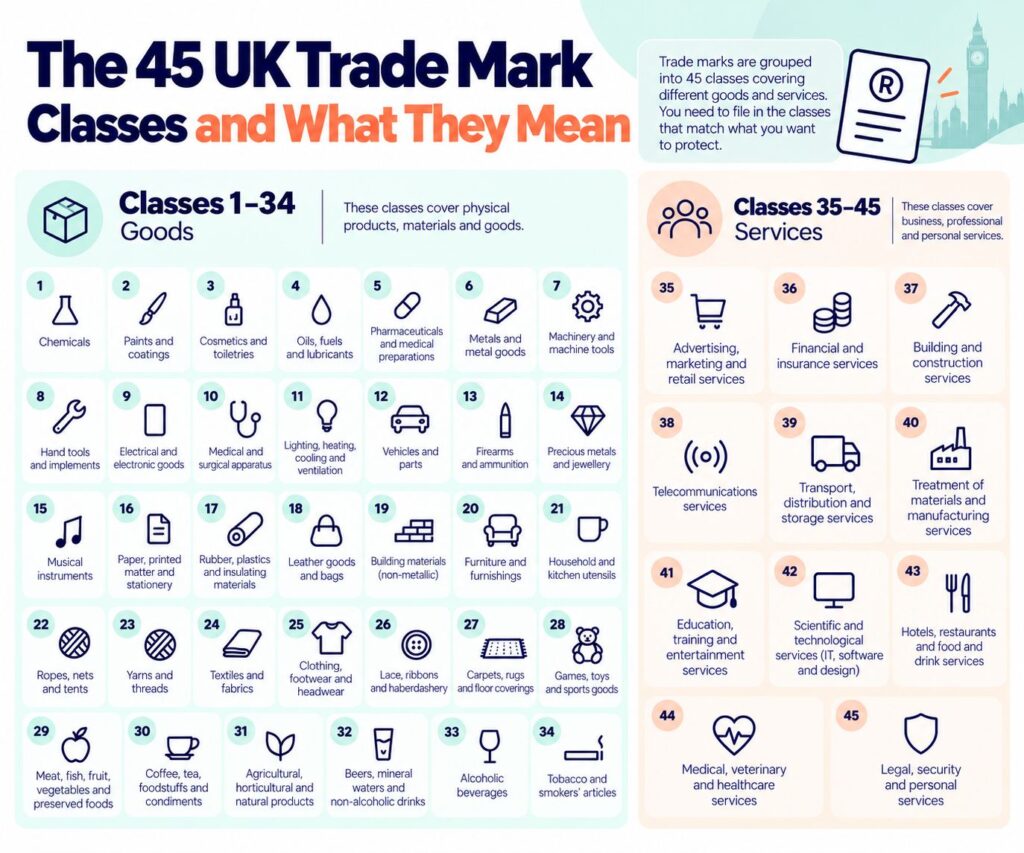
Two businesses may sometimes use similar names without infringing each other’s rights if their goods or services are sufficiently different. However, this isn’t guaranteed, particularly where there is a likelihood of confusion or an earlier trade mark has a reputation.
The IPO provides guidance on how to classify trade marks, which can help you understand which classes are relevant to your business. Or for greater certainty, a professional trade mark clearance search can assess potential conflicts across relevant classes and identify risks that may not be immediately obvious. A trade mark search specialist at Panoramix IP can help you with this.
Is Checking Companies House the Same as Checking a Trade Mark?
No, companies House and the Intellectual Property Office maintain separate registers, and they serve different purposes.
Companies House manages the registration of UK limited companies, while the IPO is responsible for registering trade marks. Registering a company name does not automatically give you exclusive trade mark rights to that name. For example, you could successfully register a limited company with Companies House, only to discover that another business already owns a registered trade mark covering similar goods or services.
This could leave you facing a legal dispute, potentially requiring you to change your business name after investing in your branding, so it’s sensible to check both registers before committing to a name.
What Happens if Someone Else Has Trade Marked Your Business Name?
Discovering an existing trade mark doesn’t necessarily mean you have to abandon your chosen business name.
The level of risk depends on several factors, including the similarity between the names, the goods or services involved, the strength of the earlier rights and the likelihood of consumer confusion. In some circumstances, two businesses can legitimately operate under similar names. In others, using the name could amount to trade mark infringement. It’s also important to remember that businesses can sometimes establish rights through use, even without registering a trade mark. These rights may be enforceable through an action known as passing off.
If your search identifies a potentially conflicting name, obtaining professional advice before proceeding could save considerable time and expense.
Can I Use a Business Name That Isn’t Trade Marked?
Potentially, but an absence of registered trade marks doesn’t guarantee that a name is safe to use. An established business may have developed valuable goodwill in an unregistered name, giving it grounds to challenge another business using confusingly similar branding.
It’s worth checking company registers, search engines, domain names and relevant industry directories alongside the official trade mark database. For businesses planning to expand internationally, additional searches may also be necessary, as UK trade mark registration generally doesn’t provide automatic protection in other countries.
Should You Register Your Business Name as a Trade Mark?
Once you’ve established that your proposed name is suitable for use, registering it as a trade mark can provide valuable legal protection.
A registered UK trade mark gives its owner exclusive rights to use the mark in relation to the goods and services covered by the registration, subject to the relevant legal rules. Registration can make it easier to prevent competitors from using confusingly similar branding and help protect the reputation you’ve worked to establish. It can also add commercial value to your business, particularly if you’re planning to expand, attract investment or license your brand.
At Panoramix IP, our trade mark registration specialists can help you assess availability, select the appropriate classes and prepare your application.
Get Expert Advice Before Registering Your Business Name
Checking whether a business name is trade marked is an important first step, but interpreting the results isn’t always straightforward.
At Panoramix IP, we help businesses identify potential trade mark conflicts, understand their legal position and secure appropriate protection for their brands.
If you’re preparing to launch a business or have concerns about an existing name, our specialists can provide clear, practical guidance on your options.
Book a free 45-minute IP clinic to discuss your business name and trade mark requirements with our team.