


11 minutes

16 October, 2026




From professional athletes and celebrities to influencers and business owners, a person’s name, photograph and likeness can have considerable commercial value.
But who actually owns the right to use your image? Can a business use your photograph without asking you? And does UK law recognise something called an ‘image right’?
The position is more complicated than it might first appear.
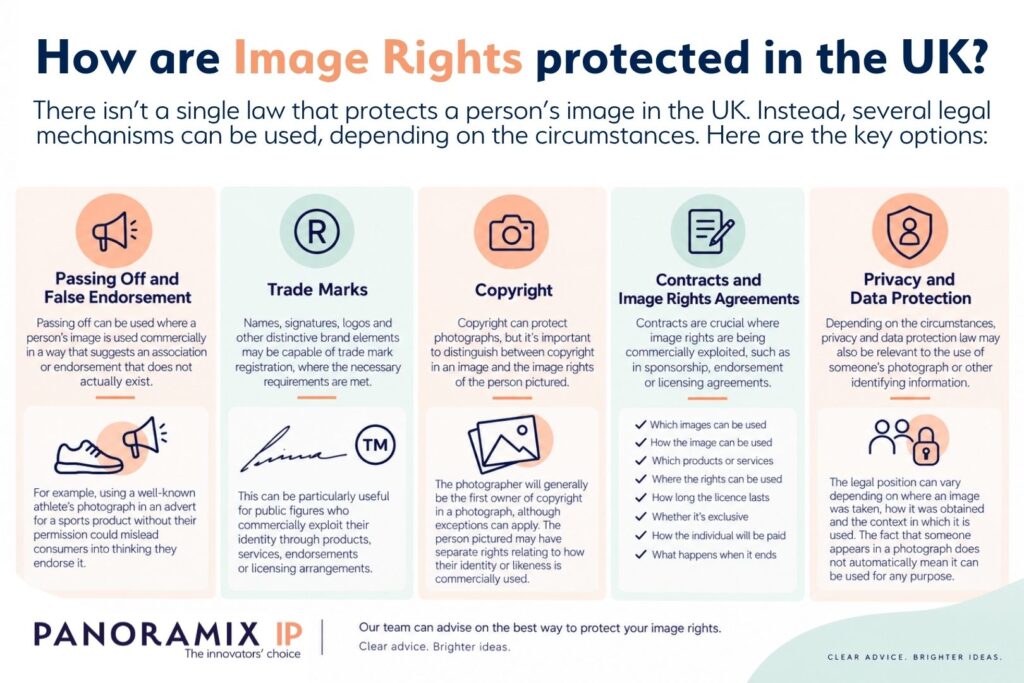
Unlike some jurisdictions, the UK does not have one standalone law that gives individuals complete ownership or control over their image. Instead, image rights in the UK can be protected through a combination of different legal rights.
In this guide, we look at what image rights are, how they are protected under UK law and what you can do if your image is used without permission.
If you need advice about a specific situation, our image rights lawyers can help you understand the protection available and the options open to you.
What Are Image Rights?
‘Image rights’ is a broad term used to describe rights associated with an individual’s identity and the way that identity is used, particularly for commercial purposes.
Despite the name, image rights are not limited to photographs.
They can potentially relate to characteristics including:
- Your name or nickname
- Your photograph
- Your likeness
- Your signature
- Your voice
- Your appearance
- Recognisable gestures or mannerisms
- Your personal brand
- Commercial endorsements and associations
For someone with a significant public profile, these characteristics can have considerable commercial value.
A professional athlete, for example, might enter into an agreement allowing a brand to use their name and photograph in an advertising campaign. An influencer might allow their likeness to be used to promote a product. A performer may license aspects of their identity for merchandise.
This is why protecting and managing image rights can form an important part of a wider intellectual property strategy.
Are There Image Rights in the UK?
One of the most important things to understand about UK image rights is that there is no single standalone image or personality right.
In other words, UK law does not simply give every individual an exclusive property right over their face, name or likeness.
Instead, protection may arise through a combination of different legal rights depending on how an individual’s identity is being used.
These can include:
- Passing off
- Trade marks
- Copyright
- Contractual rights
- Privacy and data protection
- Confidentiality
This makes image rights a particularly complex area because the legal protection available in one situation may be very different from another.
How Are Image Rights Protected in the UK?
There are several legal mechanisms that can potentially be used to protect aspects of a person’s identity.
Passing Off and False Endorsement
Passing off can be particularly relevant where a person’s image is used commercially in a way that suggests an association or endorsement that does not actually exist.
For example, imagine a well-known athlete’s photograph being used in an advertisement for a sports product without their permission.
Consumers could potentially interpret the advertisement as suggesting that the athlete uses, recommends or endorses that product.
Depending on the circumstances, this could potentially form the basis of a passing off claim.
Panoramix IP’s passing off claims lawyers can advise where the use of an image or identity may have created a misleading association with a brand, product or service.
Trade Marks
Trade marks can also play an important role in protecting a personal brand.
Names, signatures, logos and potentially other distinctive brand elements may be capable of trade mark registration where the necessary requirements are met.
This can be particularly useful for public figures who commercially exploit their identity through products, services, endorsements or licensing arrangements.
A carefully considered trade mark portfolio can therefore form one part of a broader image rights protection strategy. Find out more about Panoramix IP’s trade mark protection services.
Copyright
Copyright is another important consideration, particularly when dealing with photographs.
However, there is an important distinction between copyright in an image and the image rights of the person pictured.
Being the person shown in a photograph does not automatically mean you own the copyright.
In the UK, the photographer will generally be the first owner of copyright in a photograph, although exceptions can apply and ownership can subsequently be transferred.
This means a single photograph can potentially involve several different legal interests.
The photographer may own copyright in the photograph itself, while the person pictured may have separate rights relating to how their identity or likeness is commercially used.
You can find out more about copyright protection and what to do if protected material is being used without permission through our copyright infringement service.
Contracts and Image Rights Agreements
Contractual agreements are particularly important where image rights are being commercially exploited.
For example, sponsorship, endorsement and licensing agreements can establish precisely how an individual’s name, image or likeness may be used.
An agreement might specify:
- Which images can be used
- How an individual’s name or likeness can be used
- Which products or services the rights relate to
- Where the rights can be used
- How long the licence lasts
- Whether the arrangement is exclusive
- How the individual will be paid
- What happens when the agreement ends
Clearly drafted agreements can reduce the risk of future disputes and give both parties certainty about the extent of the rights being granted.
Our licensing agreement lawyers can advise on drafting and negotiating agreements that set clear parameters around the commercial use of intellectual property and image rights.
Privacy and Data Protection
Depending on the circumstances, privacy and data protection law may also be relevant to the use of someone’s photograph or other identifying information.
This is particularly important because the legal position can vary considerably depending on where an image was taken, how it was obtained and the context in which it is subsequently used.
The fact that someone appears in a photograph does not, on its own, answer the question of whether that photograph can be used for any purpose.
Who Owns the Copyright in an Image?
This is an area where image rights and copyright are often confused.
Generally, the person who takes a photograph is the first owner of copyright in it under UK law, subject to certain exceptions.
The individual pictured in the photograph does not automatically become the copyright owner simply because they are the subject of the photograph.
For example, if a professional photographer takes a portrait of an athlete, the photographer may own copyright in the photograph while the athlete has separate rights and commercial interests relating to the use of their identity.
This distinction becomes particularly important when photographs are used in advertising, sponsorships, social media or other commercial contexts.
If your concern relates specifically to the copying or reproduction of a photograph, our copyright infringement lawyers can advise on ownership, infringement and the options available.
Can Someone Use My Image Without Permission in the UK?
There isn’t a universal yes or no answer.
The fact that you did not give permission does not automatically mean that the use is unlawful. Equally, the fact that somebody else owns the copyright in a photograph does not necessarily mean they can use your likeness however they wish.
The circumstances surrounding the use need to be considered.
Questions may include:
- Who owns the copyright in the image?
- Where was the photograph taken?
- How was it obtained?
- Has permission previously been given?
- Is the image being used commercially?
- Does the use imply an endorsement?
- Is there an existing contractual agreement?
- Is the use misleading?
- Are privacy or data protection rights relevant?
If you discover that a business or individual is using your image without permission, it is therefore important to establish which legal rights actually apply before taking action.
Our image rights lawyers can assess the circumstances and advise on the most appropriate route.
What Should You Do If Your Image Is Being Used Without Permission?
Start by preserving evidence of the use.
This might include screenshots, website addresses, social media posts, advertisements, emails and information showing when and where the image appeared.
Avoid assuming that copyright infringement has necessarily occurred simply because you are the person in the photograph. Establishing who owns the photograph and how your image is being used will usually be an important first step.
Depending on the circumstances, possible action could include requesting removal, challenging a false endorsement, enforcing intellectual property rights, negotiating a licence or commercial settlement, or pursuing formal legal action.
Where the issue develops into a dispute, Panoramix IP’s IP dispute lawyers can advise on the available enforcement options. If the issue concerns the unauthorised copying of a protected photograph, you can also find out more about copyright infringement claims.
How Can You Protect Your Image Rights?
There is no single registration process for ‘image rights’ in the UK, so protection usually requires a broader strategy.
For individuals whose identity has significant commercial value, this might involve protecting appropriate trade marks, establishing ownership of intellectual property, putting robust licensing agreements in place and monitoring how their image is being used.
Commercial agreements should also clearly establish what a third party is and is not permitted to do.
This can be particularly important for sponsorships and endorsements, where the value of the agreement may depend heavily on how, where and for how long an individual’s identity can be used.
Our Image Rights Management service can help with tailored agreements, licensing arrangements and monitoring for unauthorised use.
Image Rights for Celebrities, Athletes and Influencers
Image rights are particularly significant for people whose personal identity forms part of their commercial value.
Professional athletes may generate income from sponsorships and endorsements. Influencers may license their image to brands. Musicians, actors and other performers may commercialise their names and likenesses through advertising and merchandise.
In these circumstances, managing image rights isn’t simply about preventing unauthorised use. It is also about creating a clear framework through which those rights can be commercially exploited.
A well-planned image rights strategy can help establish who can use an individual’s identity, under what circumstances and on what commercial terms.
Panoramix IP’s image rights lawyers can advise on protection and enforcement, while our Image Rights Management service focuses on the ongoing management and commercial use of those rights.
How to protect image rights against AI and Deepfakes?
Artificial intelligence has introduced a new dimension to image rights.
Technology can now generate realistic photographs, video and audio depicting individuals doing or saying things that never occurred.
For individuals whose identity has significant commercial value, this creates obvious concerns around impersonation, false endorsement, reputation and unauthorised commercial exploitation.
The legal remedies available will depend on the particular circumstances and may involve several areas of law rather than a standalone ‘AI image right’.
This makes proactive management of personal brands and image rights increasingly important as the technology develops.
Do You Need to Register Image Rights in the UK?
There is no UK register on which an individual can simply register ownership of their image rights.
Instead, protection may involve registering specific intellectual property rights, such as trade marks, alongside contractual and other legal protections.
The most appropriate approach will depend on what elements of an individual’s identity have commercial value and how they are currently being used.
Get Advice on Image Rights in the UK
Image rights can involve a complex combination of intellectual property, commercial and other legal rights.
Whether you are an individual looking to protect your name and likeness, a public figure managing a valuable personal brand or a business entering into an image rights agreement, understanding exactly what rights exist is an important first step.
At Panoramix IP, our specialist image rights lawyers advise clients on protecting, managing, licensing and enforcing image rights in the UK and internationally.
If you need advice about image rights, contact Panoramix IP to discuss your circumstances with our team. We also offer a free IP consultation to new customers, Free IP Clinics to book yours.
This article is intended as general information only and does not constitute legal advice.