


Choosing a name for a new business, product or service can take weeks.
You find the right name. Secure the domain. Develop the logo. Perhaps you have already started designing packaging, building the website or preparing the launch campaign.
Then you discover that somebody else owns an earlier trade mark that could cause a problem.
This is exactly why trade mark clearance should be considered before substantial time and money is invested in a new brand.
A trade mark clearance search can help establish whether your proposed name or logo is likely to encounter existing rights and identify potential issues before you proceed with a trade mark application.
But what should you actually search for, and is checking whether an identical name exists enough?
What is a trade mark clearance search?
A trade mark clearance search investigates existing trade marks and potentially relevant earlier rights before a new trade mark application is filed or a brand is launched.
The objective is not simply to determine whether your exact proposed name has already been registered.
A meaningful search should help assess the wider risk presented by existing marks that may be considered identical or similar and cover relevant goods or services.
This distinction matters.
A business could search for its exact proposed brand name, find nothing identical and assume the name is available, while overlooking a similar earlier trade mark that presents a potential obstacle.
Panoramix IP’s Trade Mark Search Services help businesses investigate existing rights and understand potential risks before committing to an application or brand launch.
Why carry out trade mark clearance before applying?
Registering a trade mark is only one part of launching and protecting a brand.
By the time an application is filed, a business may already have spent substantial amounts on:
- Naming and brand strategy
- Logo design
- Website development
- Domain names
- Packaging
- Signage
- Marketing materials
- Product development
- Advertising and launch campaigns
Discovering a potentially conflicting earlier right at this stage can be expensive.
In some circumstances, the business might need to rethink the brand, amend its application, defend opposition proceedings or negotiate with the owner of an earlier right.
A clearance search cannot guarantee that no dispute will ever arise, but it can provide a much clearer picture of the landscape before significant investment is made.
What should you check before applying for a trade mark?
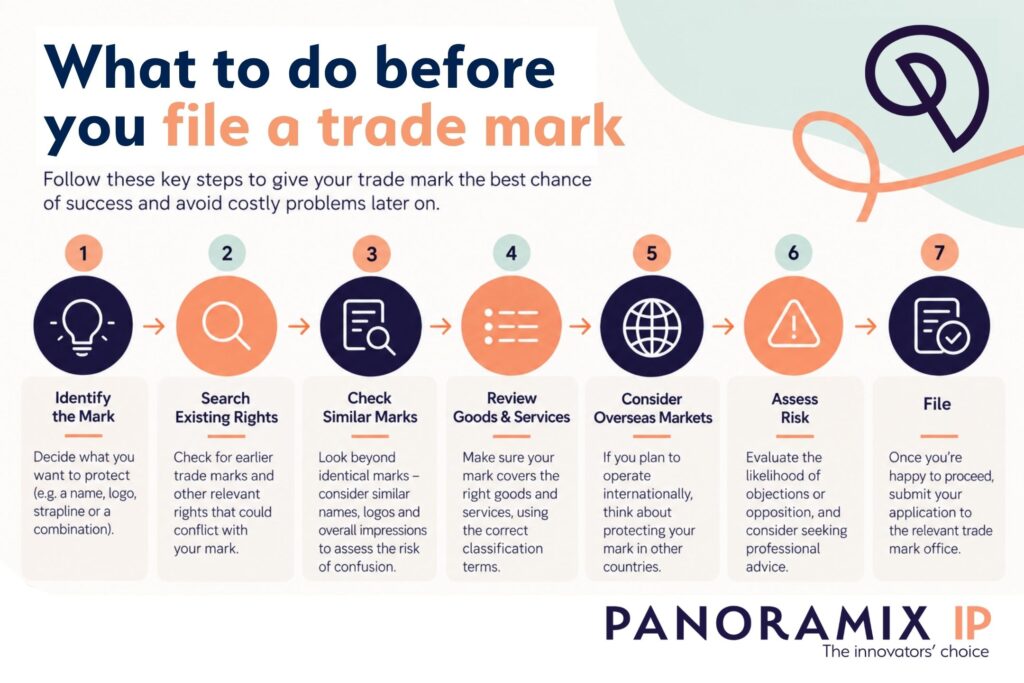
1. Search for identical registered trade marks
The obvious starting point is checking whether an identical mark has already been registered or applied for.
This is important, but it should not be the end of the search.
Trade mark conflicts are not limited to two businesses using precisely the same spelling.
2. Search for similar trade marks
A good trade mark search should also consider potentially relevant similar marks.
This might include similarities in:
- Spelling
- Pronunciation
- Appearance
- Meaning
- Overall commercial impression
A small spelling change does not necessarily make a proposed brand safe to use or register.
For example, adding a descriptive word, changing one letter or using a phonetic variation may still leave a mark sufficiently close to an earlier right to create difficulties.
This is one reason professional trade mark clearance services go further than simply typing a proposed name into a database.
3. Check the relevant goods and services
Trade marks are registered in relation to specified goods and services.
This means finding the same or a similar name on the register does not automatically tell you whether your proposed application is problematic.
You need to consider what the earlier trade mark actually protects and whether those goods or services overlap with, or are sufficiently similar to, your own.
A business selling software, for example, needs to think carefully about the particular type of software and associated services it intends to provide rather than simply deciding that it belongs in a broad “technology” category.
Getting the specification right at the filing stage is an important part of effective trade mark protection.
4. Consider unregistered rights
The trade mark register is extremely important, but registered trade marks are not necessarily the only rights that need to be considered.
A business may potentially have established rights through use of a brand even where that brand has not been registered as a UK trade mark.
This means a register search should form part of a broader assessment rather than being treated as an absolute guarantee that a name is free to use.
Depending on the circumstances, searches may also consider company names, websites, domain names, marketplaces and general commercial use.
5. Check company names and domain names
Registering a company name at Companies House is not the same as registering a trade mark.
Likewise, owning a domain name does not automatically give you the right to use that name as a trade mark.
However, company and domain searches can still provide useful information when assessing the commercial landscape around a proposed brand.
If another business is already operating under a similar name in a related sector, this may warrant closer investigation even if your initial trade mark register search does not reveal an obvious identical registration.
6. Think beyond the UK
If you intend to trade internationally, a UK-only search may not tell you everything you need to know.
Trade mark rights are territorial.
A brand that appears available in the UK may encounter existing rights when the business expands into Europe, the United States or another important market.
It is therefore worth considering future expansion before committing heavily to a brand.
Where international growth is part of the plan, Panoramix IP can help businesses develop an international IP strategy that considers the territories that matter commercially.
Can I check a trade mark myself?
The UK trade mark register can be searched publicly, so it is certainly possible to carry out an initial search yourself.
This can be useful during the early stages of naming a business or product.
The more difficult question is not necessarily whether a result exists, but what that result means.
Would a similar mark create a meaningful risk? Are the goods and services sufficiently close? Does an earlier registration cover areas relevant to your proposed business? Is there a sensible way to adjust the application?
Professional clearance work combines searching with analysis.
That becomes particularly valuable where the brand is commercially important, significant investment is planned or the search reveals potentially relevant earlier rights.
What happens if you find a similar trade mark?
Finding a similar trade mark does not automatically mean that you must abandon your proposed brand.
The level of risk depends on the particular marks, their goods and services, the territories involved and other relevant circumstances.
Possible next steps might include:
- Proceeding with the application
- Refining the goods and services covered
- Modifying the proposed mark
- Approaching the owner of an earlier right
- Exploring a coexistence agreement
- Choosing an alternative brand
- Seeking further advice before making a commercial decision
The important point is that these decisions can be made before significant investment is committed, rather than after a dispute arises.
Where a potential conflict has already developed, advice on trade mark disputes and enforcement may also be required.
What happens after a trade mark clearance search?
If the search results are favourable and the risk is considered acceptable, the next stage will usually be preparing and filing the trade mark application.
This includes deciding:
- Who should own the trade mark
- Exactly what mark should be protected
- Which goods and services should be included
- Which classes are appropriate
- Which countries require protection
These decisions matter.
A trade mark registration is a business asset, and the application should be structured around how the brand is actually used and how the business expects it to develop.
For founders and growing businesses, considering these issues as part of a broader IP strategy can help avoid having to untangle ownership or protection issues later.
Trade mark clearance is about managing risk before you invest
A new brand can quickly become one of a business’s most valuable assets.
That makes it worth asking the right questions before committing to it.
A trade mark clearance search can identify potential conflicts at an early stage, allowing you to make an informed decision about whether to proceed, adapt your plans or investigate an issue further.
At Panoramix IP, our trade mark attorneys and solicitors provide trade mark search and clearance services alongside filing, prosecution and wider brand protection advice.
Whether you are launching a new business, introducing a product, rebranding or expanding an established brand into new markets, we can help you understand the existing trade mark landscape before you make your next move.
Planning a new brand or trade mark application? Get in touch with Panoramix IP to discuss a trade mark clearance search.