


Software is at the heart of innovation across almost every industry, from healthcare and manufacturing to finance, engineering and artificial intelligence. As businesses invest more time and money into developing bespoke software, one question comes up time and time again: can you get a patent for software?
The answer is yes, in some circumstances. Although UK patent law excludes computer programs “as such” from patent protection, this does not mean software can never be patented. Many software-based inventions are successfully patented because they solve a technical problem in an innovative way. Understanding where that line is drawn can be challenging, which is why seeking advice early is often worthwhile.
In this guide, our IT and software patent attorneys explain when software can be patented in the UK, what makes software patentable, and how to determine whether your invention could qualify for protection.
Can Software Be Patented in the UK?
Yes, you can obtain patents on software in the UK, but not every piece of software will meet the legal requirements.
Under the Patents Act 1977, computer programs are excluded from patent protection “as such”. This wording often causes confusion, leading many people to believe that software patents simply are not possible. In reality, the UK Intellectual Property Office looks at the invention as a whole rather than focusing solely on the fact that it involves software.
The key question is whether the software provides a genuine technical solution to a technical problem. If it does, there may be an opportunity to complete a successful patent software application. If the software simply carries out an administrative, commercial or mathematical process in a conventional way, it is far less likely to qualify.
Why Is Software Excluded “As Such”?
Patent law is designed to reward genuine technical innovation rather than abstract ideas. If every computer program were patentable simply because it performed a particular task, it could make it much harder for others to develop similar software and could ultimately restrict innovation across the industry.
This is why the law excludes software that merely automates existing business processes, performs routine calculations or presents information without delivering any technical improvement. The exclusion is intended to prevent ideas from being monopolised while still allowing genuinely innovative technological developments to be protected.
That said, software which improves how technology functions, enhances computer performance or solves a technical problem may still satisfy the requirements for a patent.
What Makes Software Patentable?
When assessing software inventions, the most important consideration is whether the invention makes a technical contribution. In simple terms, the software must do more than perform a business function or automate an existing manual process. Instead, it should provide a technical solution that produces a technical effect.
Examples of patentable software inventions may include software that…
- Improves computer performance
- Controls industrial machinery or robotics
- Enhances cybersecurity
- Processes medical imaging
Improves communications technology - Controls sensors and connected hardware.
Artificial intelligence can also form part of a patentable invention where it is solving a technical problem rather than simply analysing data or automating routine decision-making.
Every invention is assessed on its own merits, so there is no definitive checklist that guarantees whether software will qualify. Often, the overall technical effect of the invention is far more important than the programming itself.
Unsure if your invention is patentable? Click here to book a free 45-minute consultation with a software patent lawyer at Panoramix IP, who will be able to check if you meet requirements, complete an existing software patent search, and advise you on how to patent software successfully.
Examples of Software That May Not Be Patentable
Equally, there are many types of software that are less likely to satisfy the legal requirements for patent protection. This does not necessarily mean they have no value or cannot be protected in other ways, but patents may not be the most appropriate form of intellectual property.
Examples of software that is not patentable include:
- Accounting software
- Customer relationship management systems
- Loyalty schemes
- Booking platforms
- Financial trading methods
- Mobile applications that simply implement standard business processes without introducing any technical innovation.
The fact that software is commercially successful does not automatically make it patentable.
Can AI Software Be Patented?
Artificial intelligence has become one of the fastest-growing areas of innovation, and many businesses developing AI-powered software naturally want to understand whether it can be patented. The answer depends less on the fact that artificial intelligence is being used and more on what the technology actually achieves.
For example, an AI system that improves industrial automation, enhances computer security, advances image recognition or solves an engineering problem through a technical innovation may be capable of patent protection. On the other hand, an AI tool that simply automates an administrative task or business workflow is less likely to satisfy the legal tests.
As AI technology continues to develop at pace, obtaining specialist advice before filing a patent application can help you avoid unnecessary costs and maximise your chances of securing meaningful protection.
Patent vs Copyright for Software
Many people assume that copyright and patents provide the same protection for software, but they serve very different purposes.
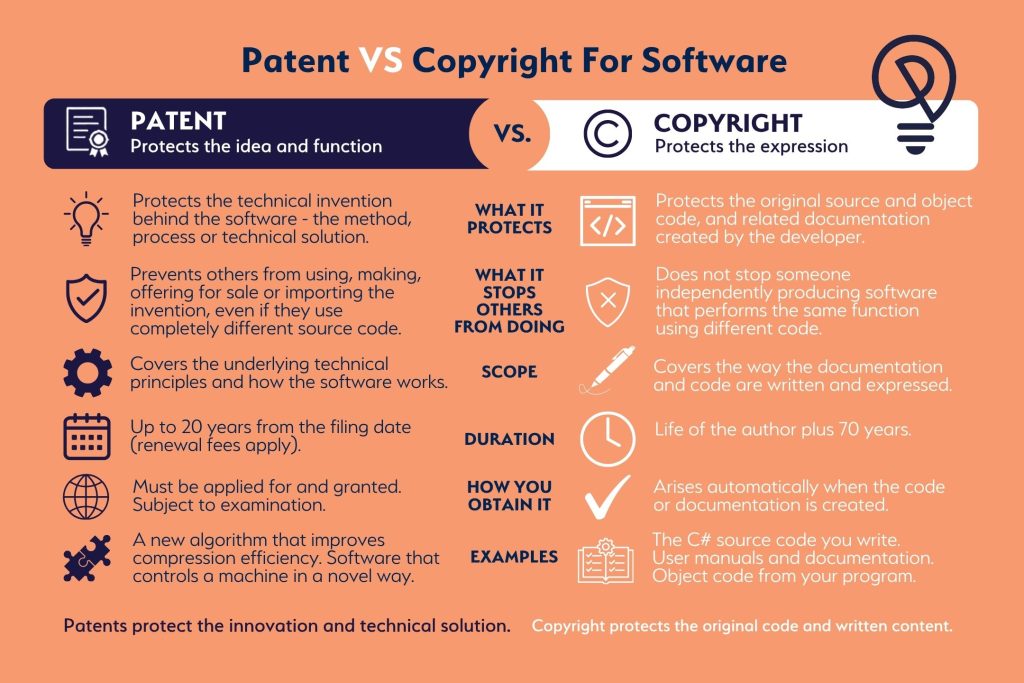
A patent protects the technical invention behind the software. It can prevent competitors from using the underlying method, process or technical solution, even if they develop completely different source code.
Copyright, by contrast, automatically protects the original source code, object code and related documentation created by the developer. It does not stop someone independently producing software that performs the same function using different code.
In many cases, the strongest protection comes from using both forms of intellectual property together, alongside appropriate confidentiality agreements and commercial contracts.
What To Do If Your Software Cannot Be Patented
Not every software innovation will qualify for patent protection, but that does not mean your intellectual property cannot be protected.
Depending on your circumstances, you may still benefit from copyright protection for your source code, keeping key algorithms as trade secrets, using non-disclosure agreements before sharing confidential information, registering trade marks for your software brand or product names, and putting robust licensing agreements in place to define ownership and usage rights.
Choosing the right combination of intellectual property rights is often just as important as deciding whether to pursue a patent, particularly for software businesses operating in competitive markets.
How To Patent a Software Idea
If you think that your software could qualify for patent protection, the first step is to speak with one of our experienced patent attorneys for software.
This is because software patents are one of the more complex areas of intellectual property law, and whether an invention is patentable often depends on how it is assessed and, importantly, how the patent application is drafted. Therefore, we’d advise that you get it right the first time around, by working with a partner who is experienced in software patent law.
At Panoramix IP, we work with software developers, technology startups and established businesses to assess whether software-based inventions are likely to meet the requirements for patent protection. We’ll take the time to understand how your software works, identify the technical innovation behind it and advise on the most appropriate strategy for protecting your intellectual property.
Where a patent is the right option, we’ll guide you through every stage of the process, from assessing patentability and carrying out prior art searches to drafting a robust patent application and managing the application through to grant. If a patent isn’t the best fit, we’ll explain the alternatives and help you build an IP strategy that protects your software and supports your commercial goals.
To find out whether your software could be patented, get in touch with one of our patent attorneys today. We’ll help you to understand your options and the best route to protecting your innovation.