


Developing a new product or invention often requires significant investment, from research and development through to testing, manufacturing and marketing. However, many businesses overlook one crucial step: securing patent protection.
While not every invention needs a patent, choosing not to protect your innovation can expose your business to a range of commercial and legal risks. Without the exclusive rights that a patent provides, competitors may be free to copy your invention, eroding your competitive advantage and reducing the return on your investment.
In this guide, our Nottinghamshire patent lawyers explore the key risks of not having a patent, explain why patent protection matters, and discuss how seeking professional advice can help you make informed decisions about protecting your intellectual property.
What Does a Patent Actually Protect?
A patent is a legal right that protects a new and inventive product, process or technical solution. Once granted, it gives the patent owner the exclusive right to prevent others from making, using, selling, importing or otherwise exploiting the patented invention without permission for a limited period, usually up to 20 years, provided renewal fees are paid.
Patent protection allows businesses to safeguard their innovations, helping to ensure that competitors cannot simply replicate the time, effort and investment that went into developing a new invention. For many businesses, patents form an important part of a wider intellectual property strategy, alongside trade marks, registered designs and copyright.
Can You Sell an Invention Without a Patent?
Yes, there is no legal requirement to obtain a patent before selling an invention.
However, selling an invention without patent protection means you may have little or no protection if competitors choose to produce similar products. Once your innovation enters the marketplace, it may become easier for others to analyse, replicate and commercialise comparable solutions, potentially reducing your commercial advantage.
Whether a patent is appropriate will depend on your invention, your business objectives and your long-term commercial strategy. Understanding the risks of not having a patent can help you decide whether seeking patent protection is the right course of action.
The Top 7 Risks Of Not Having A Patent
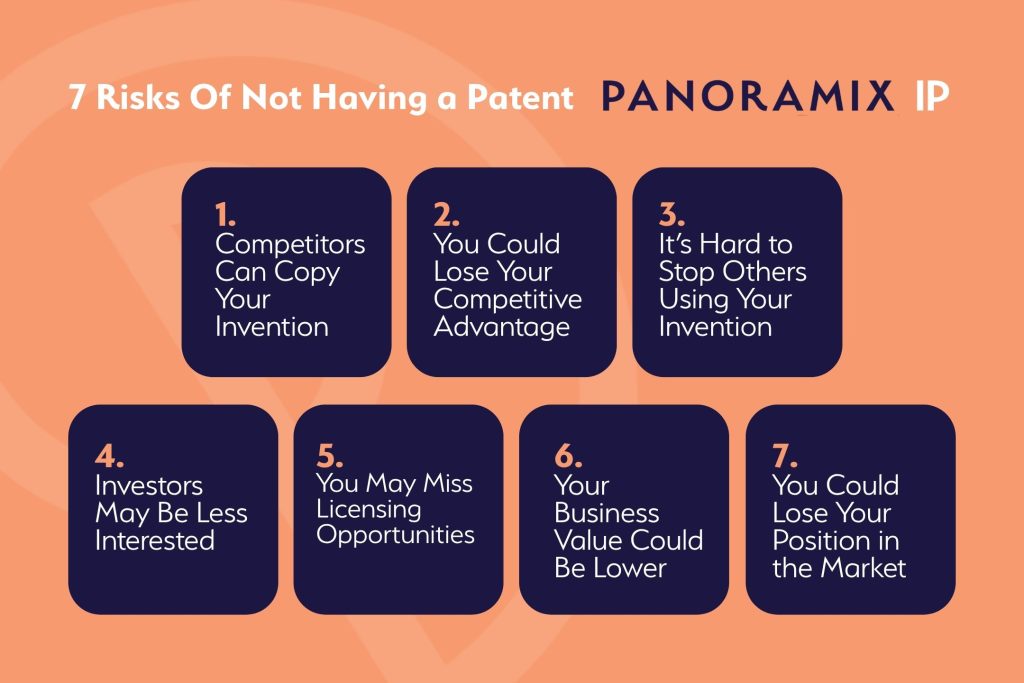
1. Competitors Can Copy Your Invention
One of the biggest risks of not having a patent is that competitors may be able to develop similar products based on your innovation.
Bringing a new invention to market often requires considerable time, expertise and financial investment. Without patent protection, competitors may be able to benefit from your hard work without incurring the same development costs.
In some cases, larger businesses with greater manufacturing capabilities or marketing budgets may even be able to introduce competing products more quickly and at a lower price, making it harder for your business to compete effectively.
2. You Could Lose Your Competitive Advantage
Innovation is often what sets a business apart from its competitors. A unique product, manufacturing process or technical improvement can provide a valuable competitive advantage within the marketplace.
Without patent rights, however, that advantage may be short-lived. If competing businesses are able to produce similar products, your point of difference may quickly diminish.
As more competitors enter the market with comparable offerings, maintaining premium pricing, attracting new customers and differentiating your business can become increasingly challenging.
3. It Can Be Difficult to Stop Others Using Your Invention
Patents provide enforceable legal rights that may enable patent owners to take action where their invention is used without permission.
If you do not have patent protection, your options for preventing others from making, selling or using similar inventions may be significantly more limited.
Although other areas of intellectual property law may sometimes offer protection depending on the circumstances, they are not a substitute for patent rights where patent protection is available. Without a patent, enforcing your rights against competitors can often be considerably more difficult.
4. Investors May Have Concerns
Intellectual property is frequently an important consideration for investors, particularly when assessing innovative businesses or technology-led companies.
A patent can demonstrate that a business has taken steps to protect its innovation and may help create barriers to entry for competitors. This can provide investors with greater confidence in the long-term commercial potential of a product or business. If you watch Dragon’s Den, you’ll have likely seen a dragon pulling an offer because a patent isn’t in place.
Conversely, where valuable innovations remain unprotected, some investors may perceive a greater level of commercial risk, particularly if competitors could potentially introduce similar products without restriction.
5. You May Miss Licensing Opportunities
A patent does more than protect your own products, it can also create opportunities to generate revenue through licensing.
Patent owners may choose to license their invention to other businesses in exchange for royalties or licence fees, allowing others to manufacture or use the invention under agreed terms.
Without exclusive patent rights, negotiating licensing agreements may become considerably more difficult, as there may be little to prevent others from developing comparable products independently.
For businesses looking to maximise the commercial value of their innovation, patent protection can form an important part of a wider licensing strategy.
6. Your Business Value Could Be Lower
Patents are often valuable business assets.
Whether you’re seeking investment, planning for future growth or preparing your business for acquisition, a well-managed patent portfolio can enhance the overall value of your company.
Protected intellectual property demonstrates innovation, creates commercially valuable assets and may increase confidence among investors, buyers and commercial partners.
Without a patent in place, your business may have fewer tangible intellectual property assets to support its valuation, potentially reducing its attractiveness during investment or acquisition discussions.
7. You Could Lose Your Position in the Market
If your innovation isn’t patented, competitors may be able to enter the market with similar products more easily.
Businesses with greater financial resources, established distribution networks or larger marketing budgets may be able to scale production more quickly and capture market share using comparable products or technologies.
As the market becomes more crowded, your innovation may no longer provide the same competitive edge it once did. This can make it more difficult to retain customers, justify premium pricing and achieve the commercial return you originally expected from your investment.
Protecting innovative products through a patent can help strengthen your market position and support long-term commercial success.
Is Every Invention Worth Patenting?
Not necessarily.
While patents can provide significant commercial benefits, they are not the right solution for every invention. Deciding whether to pursue a patent should involve careful consideration of several factors, including:
- The commercial value of the invention.
- The size of the potential market.
- How easily competitors could replicate the innovation.
- The expected lifespan of the product.
- The costs associated with obtaining and maintaining patent protection.
- Your wider business and commercial objectives.
An experienced patent attorney at Panoramix IP can help assess whether patent protection is appropriate and advise on the most effective strategy for protecting your intellectual property.
When To Use a Patent Application Attorney
Obtaining a patent involves far more than completing an application form. A carefully prepared patent application can play a significant role in determining the strength and scope of the protection ultimately obtained.
Our patent attorneys can help you:
- Assess whether your invention may be patentable.
- Develop an appropriate filing strategy.
- Prepare and draft a robust patent application.
- Advise on UK and international patent protection.
- Align your intellectual property strategy with your commercial objectives.
At Panoramix IP, our experienced patent lawyers work closely with businesses, entrepreneurs and innovators to help protect valuable inventions and maximise their commercial potential. If you’re considering your first patent application or developing a wider intellectual property strategy, we’re here to help. Click here to get in touch with a member of our IP firm.
Book a Free Patent Consultation
If you’ve developed an innovative product or process and would like to discuss whether patent protection is right for your business, we offer a free 45-minute consultation. In this consultation, we’ll discuss your IP requirements and explore first steps to securing patent protection for your innovation. Click here to book yours!