


From software and website content to logos, photographs and marketing materials, businesses create valuable intellectual property every day. Understanding how copyright differs from a trade mark is essential if you want to make sure those assets are properly protected.
Although both are forms of intellectual property, they serve very different purposes, and knowing which one applies to your work can help you avoid costly disputes while ensuring your business retains ownership of its most valuable assets.
Many people assume that copyright and trade marks offer the same type of protection, or that simply creating something automatically protects every aspect of it. In reality, the two rights exist for different reasons. Copyright protects original creative works, while trade marks protect the brands that customers recognise and trust. Understanding the distinction is often the first step towards developing an effective intellectual property strategy.
In this article, our international and UK copyright lawyers at Panoramix IP advise on what copyright protection means, when it’s important, and what the difference is between copyright and trade marks.
What Is Copyright?
The definition of copyright is a legal right that protects original creative works from being copied, reproduced or used without the permission of the copyright owner.
Unlike patents, trade marks and registered designs, copyright arises automatically as soon as an original work is created and recorded in a tangible form. There is no official copyright registration system in the UK, meaning creators do not need to submit an application before their work receives legal protection.
Copyright applies to a wide range of creative works, including books, articles, website content, software, photographs, artwork, films, music, sound recordings, technical drawings and databases. As long as the work is original and meets the legal requirements for copyright protection, the creator will usually own copyright from the moment it is created, although ownership can differ in certain situations, such as where work has been produced by an employee as part of their role or where contractual arrangements state otherwise.
The purpose of copyright is to give creators control over how their work is used. In most cases, the copyright owner has the exclusive right to copy, publish, distribute, licence or adapt their work, preventing others from using it without permission. Copyright can also become a valuable commercial asset, allowing businesses to generate income through licensing agreements or by enforcing their rights against those who copy their work unlawfully.
It is important to remember that copyright protects the expression of an idea rather than the idea itself. For example, copyright can protect the words used in a blog article or the source code behind a software application, but it does not prevent somebody else from creating their own work based on the same concept, provided they do not copy the original expression.
What’s the Difference Between Copyright and a Trade Mark?
Although copyright and trade marks are both intellectual property rights, they protect completely different aspects of a business. Copyright focuses on original creative works, while a trade mark protects the identity of a business, including the names, logos and branding that customers use to recognise its products or services.
Understanding this distinction is essential, as choosing the wrong type of protection can leave valuable assets exposed. See our useful graphic below to better understand the differences between copyright and trade marks.
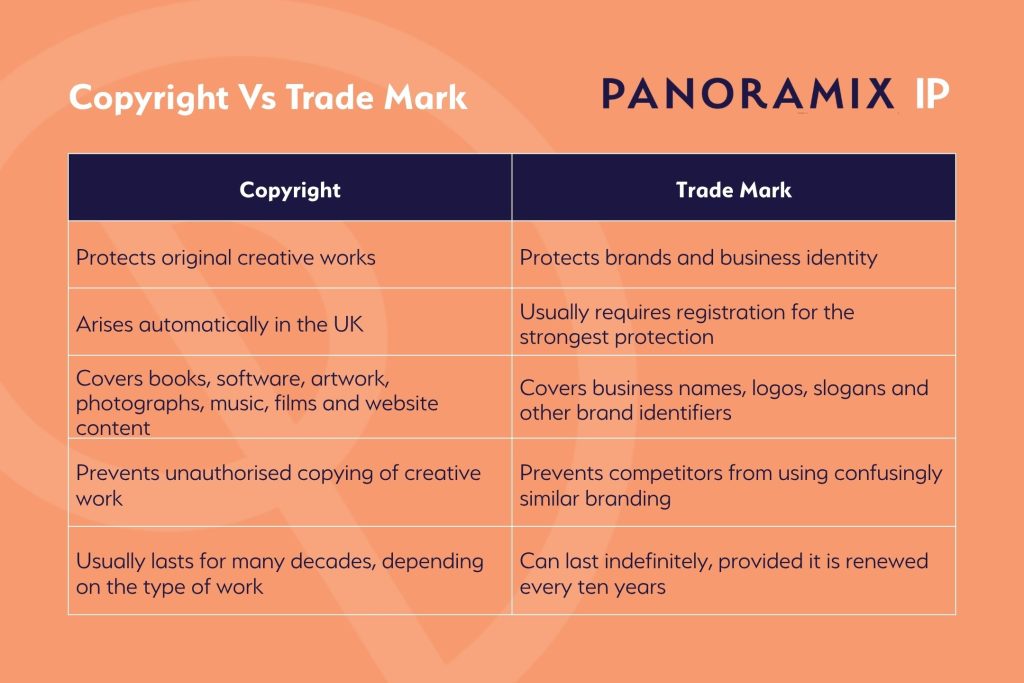
A common misunderstanding is that copyright protects business names or company names. In reality, names, titles and short phrases are not generally protected by copyright. If your priority is preventing another business from trading under a similar name or using a logo that could confuse customers, registering a trade mark is usually the most effective solution.
There are situations where both rights apply to the same asset. An original logo, for example, may attract copyright because it is an artistic work, while registering that same logo as a trade mark protects the brand it represents. Together, these rights provide broader protection than either could offer on its own.
When Do You Need Copyright?
If your business creates original content, there is a good chance you already own valuable copyright. Every website page you write, photograph you commission, software application you develop or marketing brochure you produce has the potential to become an important business asset. Copyright exists to ensure that other people cannot simply copy that work and benefit from the time, effort and investment that went into creating it.
Businesses regularly rely on copyright to protect a wide variety of creative works, including:
- Website content and blog articles
- Product descriptions and marketing materials
- Software, mobile applications and source code
- Photographs, illustrations and graphic design
- Videos, animations and other multimedia content
- Technical drawings, plans and architectural designs
- User manuals, guides and instructional materials
- Original artwork, music and other creative works
For many organisations, these assets form an important part of their competitive advantage, making it essential to understand who owns the copyright and how those rights can be enforced if infringement occurs.
Although copyright arises automatically, ownership is not always as straightforward as people expect. Work created by employees is often owned by the employer, while material produced by freelancers, agencies or external contractors may remain the property of the creator unless ownership has been formally assigned. Taking professional advice and ensuring contracts clearly address intellectual property ownership can help avoid expensive disputes in the future.
Can You Have Both Copyright and a Trade Mark?
Yes, and in many cases having both forms of protection is the most effective way to safeguard your intellectual property.
Consider a business logo. The artwork itself may be protected by copyright because it is an original artistic creation. However, copyright alone is unlikely to stop another business from adopting similar branding if the issue relates to customer confusion rather than copying the artwork itself. Registering the logo as a trade mark provides additional protection by giving the owner exclusive rights to use that logo in connection with the goods or services for which it has been registered.
The same principle applies to many businesses. A software company may own copyright in its source code, documentation and website content while also registering its company name, product names and logo as trade marks. Using copyright alongside trade mark registration creates a more comprehensive intellectual property strategy, protecting both the creative work your business produces and the reputation your brand has built over time.
To better understand whether you need copyright protection or a trade mark (or both), click here to book a 45-minute IP and copyright consultation for free, with one of our copyright attorneys.
How Do I Register Copyright?
One of the questions we’re asked most often is how to register copyright in the UK. The answer is surprisingly simple, because unlike trade marks, patents and registered designs, there is no official copyright register. In most cases, copyright protection arises automatically as soon as an original work is created and recorded in a tangible form, meaning there is no application process and no government register to apply to.
Although registration is not required, keeping clear records of when work was created, who created it and who owns the copyright is still extremely important. Good record keeping can make it much easier to prove ownership if your rights are ever challenged or if you need to take action against somebody who has copied your work without permission.
If you’re unsure whether copyright provides sufficient protection, or you’re wondering whether your business would also benefit from registering a trade mark, professional advice from a copyright solicitor can help you make the right decision from the outset.
At Panoramix IP, our experienced intellectual property lawyers offer a variety of copyright protection services. Our team advise businesses, entrepreneurs and creators on every aspect of intellectual property, including copyright, trade marks, patents and design rights. We offer free 45-minute IP Clinics, giving you the opportunity to discuss your ideas, understand your options and put the right protection in place before problems arise. Click here to book your free copyright consultation.
What Should You Do If Someone Is Infringing Your Copyright?
If you believe that somebody is infringing your copyright, seeking professional legal advice from one of our copyright infringement lawyers as early as possible can help you protect your rights and avoid taking steps that may weaken your position.
Copyright infringement occurs when someone copies, reproduces, publishes, distributes or otherwise uses your original work without your permission and without a valid legal defence. Common examples include copying website content, reproducing photographs without consent, using software code unlawfully, republishing blog articles, sharing marketing materials or using creative works for commercial purposes without the copyright owner’s permission.
If you suspect somebody has infringed your copyright, there are several practical steps you should take as soon as possible:
- Contact an experienced intellectual property lawyer at Panoramix IP to understand your legal rights and the options available.
- Gather evidence of the infringement, including screenshots, website links and copies of the original work.
- Keep records showing when the work was created and demonstrating that you own the copyright.
- Avoid contacting the other party before taking legal advice, particularly if the infringement involves a commercial competitor
Every copyright dispute is different, so the most appropriate course of action will depend on the circumstances. In many cases, matters can be resolved without court proceedings by sending a carefully drafted copyright cease and desist letter, negotiating a licence or settlement, or securing the removal of the infringing content. Where a dispute cannot be resolved amicably, legal action may be necessary to stop the infringement and recover damages.
If somebody has copied your work, don’t assume there’s nothing you can do. Get in touch with an experienced copyright lawyer at Panoramix IP today. Our team will explain your options in plain English and work with you to develop a practical, commercially focused strategy for protecting your intellectual property.