


You have developed something new. Perhaps it is a product, piece of technology, manufacturing process or technical solution to an existing problem.
The next question is often: how do I protect it?
For inventions that meet the relevant requirements, a patent can provide powerful protection. However, filing a patent is not simply a matter of registering an idea. A UK patent application is a technical and legal document, and decisions made during the drafting and filing process can have a significant impact on the protection ultimately obtained.
Here, we take you through the process of filing a patent in the UK, from the initial assessment through to examination and grant.
What can you patent in the UK?
Broadly speaking, an invention must meet certain requirements to be patentable.
It needs to be new, involve an inventive step and fall within patentable subject matter.
One of the most important considerations is novelty. If an invention has already been made publicly available, this can potentially prevent valid patent protection from being obtained.
Businesses should therefore think carefully before revealing an invention at a trade show, publishing details online, presenting it publicly or discussing it with third parties.
If information needs to be shared before filing, appropriate confidentiality agreements may help protect sensitive information.
Our 10 Step Guide To UK Patent Filing
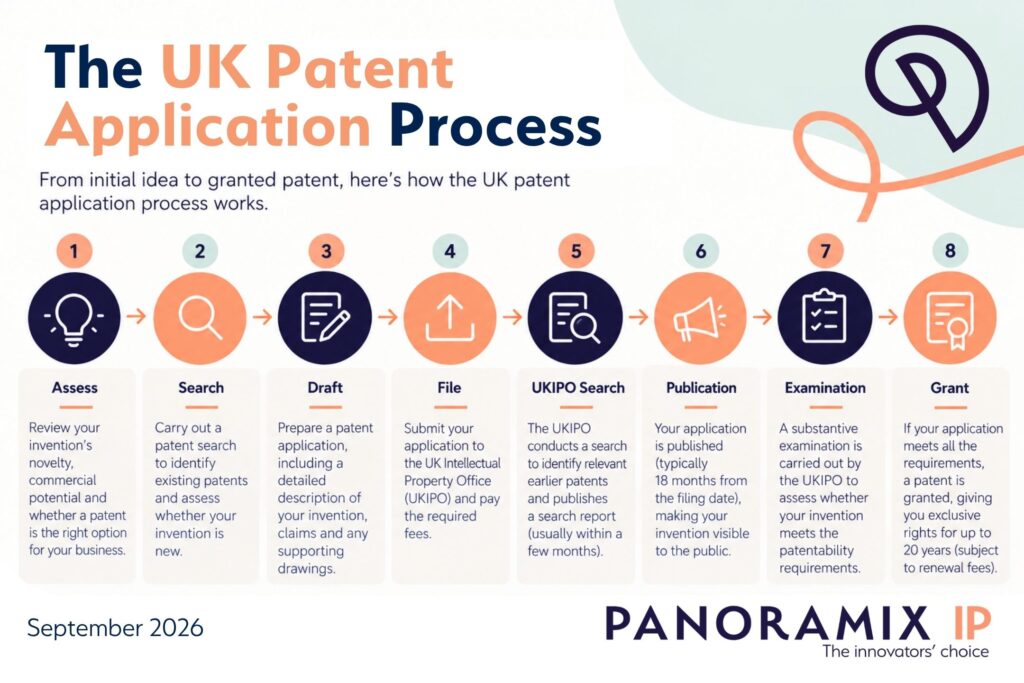
Step 1: Decide whether a patent is the right form of protection
The first question should not necessarily be “how do we file a patent?” but “what are we trying to protect and why?”
Are you trying to stop competitors copying a core technology? Create an asset that could later be licensed? Support investment? Protect a product before launch? Build a patent portfolio around an emerging technology?
Patent protection should support the wider commercial strategy rather than exist in isolation.
In some circumstances, other forms of intellectual property, including trade secrets, copyright or registered designs, may also need to be considered.
Developing a clear patent strategy at an early stage can help establish what should be protected, where protection is needed and how filing fits with the wider commercial plan.
Step 2: Keep your invention confidential
Before you file a patent application, confidentiality matters.
A common misconception is that because you invented something yourself, you can talk about it publicly and simply apply for a patent afterwards.
That can be risky.
Patent protection generally depends on the invention being new. A public disclosure before filing can therefore create serious problems.
Consider who has access to the invention internally and whether information has already been shared with suppliers, developers, manufacturers, investors or potential commercial partners.
Where disclosure is necessary, appropriate confidentiality arrangements should be considered before sensitive information is shared.
Step 3: Carry out a patent search
Before investing heavily in a patent application, it can be sensible to investigate what already exists.
A patent search can identify earlier patents and published patent applications that may be relevant to your invention. These documents can form part of what is known as the prior art.
Finding similar technology does not automatically mean your invention cannot be patented.
The important questions are how your invention differs from what has already been disclosed and whether those differences may support patentability.
A professionally conducted search can also help inform how the application is drafted and where the potentially valuable aspects of the invention lie.
Panoramix IP can assist businesses with patent searches and patent protection as part of the wider filing strategy.
Step 4: Think about where you need patent protection
A UK patent provides protection in the UK. It does not automatically give you patent rights throughout Europe or internationally.
That makes geography an important commercial consideration.
Where will you manufacture the product? Where are your main customers? Where are your competitors based? Which markets are likely to become commercially important?
You do not necessarily need to file everywhere, but you do need to understand which territories matter before relevant deadlines arrive.
For businesses operating internationally, Panoramix IP can help develop a filing strategy that considers UK protection alongside appropriate international IP protection.
Step 5: Prepare the patent application
This is one of the most important stages of the entire process.
A patent application needs to explain the invention in sufficient technical detail and set out the scope of the protection being sought.
A UK patent application will typically contain:
- A description of the invention
- Claims defining the technical features for which protection is sought
- An abstract
- Drawings, where appropriate
The claims are particularly important because they ultimately define the scope of patent protection.
Draft them too narrowly and a competitor may potentially find a relatively straightforward way around the patent. Draft them too broadly without adequate support and the application may face objections.
Effective patent drafting therefore requires an understanding of both the underlying technology and patent law.
This is one of the key reasons businesses often use professional patent filing services rather than approaching the application simply as an administrative form-filling exercise.
Step 6: File your UK patent application
Once the application is ready, it can be filed with the UK Intellectual Property Office.
Filing establishes an important filing date for the application.
Depending on the circumstances, an applicant can initially seek a filing date and request search and examination at the appropriate stages, or request additional steps when the application is filed.
The most appropriate approach depends on the invention, its stage of development and the wider filing strategy.
Panoramix IP’s patent protection services can support businesses through drafting, filing and prosecution of UK and international patent applications.
Step 7: The UKIPO patent search
The UKIPO carries out a search to identify documents that may be relevant to whether the claimed invention is new and inventive.
The search report can provide an important early indication of prior art that could affect the application.
This does not necessarily determine whether a patent will ultimately be granted, but it can help the applicant and patent attorney understand the issues likely to arise as the application progresses.
Step 8: Publication of the patent application
A UK patent application is normally published approximately 18 months after its filing or priority date.
At this point, the application and details of the invention become publicly accessible.
Importantly, publication does not mean that the patent has been granted.
The application must still go through substantive examination.
Businesses should therefore avoid treating a published patent application as though the patenting process is complete.
Step 9: Substantive examination
During substantive examination, a UKIPO examiner considers whether the application meets the requirements for a patent to be granted.
The examiner may identify objections.
This is not necessarily unusual or the end of the road. Depending on the objections raised, there may be opportunities to respond with legal and technical arguments and/or make appropriate amendments to the application.
How those objections are handled can have a significant impact on the eventual scope of protection.
This is where the ongoing work of a patent attorney becomes particularly valuable: the aim is not simply to obtain a patent, but to pursue commercially useful protection wherever possible.
Step 10: Patent grant
If the UKIPO is satisfied that the relevant requirements have been met and outstanding issues have been resolved, the patent can proceed to grant.
Grant is not the end of the IP strategy.
A granted patent then needs to be managed as a commercial asset. This may include paying renewal fees, monitoring competitors, considering potential infringement and evaluating opportunities for patent licensing.
Your patent portfolio should also be reviewed as the business develops. New products, improvements and technical developments may create further opportunities for protection.
How long does it take to get a patent in the UK?
Patent applications are not generally granted immediately.
The standard UK process includes filing, search, publication and substantive examination, and the complete process can take several years.
There are circumstances in which accelerated processing may be available, so businesses working towards an investment, launch or other commercial deadline should raise this with their patent attorney at an early stage.
Do I need a patent attorney to file a patent?
It is possible to file a UK patent application yourself, but obtaining meaningful patent protection is considerably more complicated than submitting an application form.
The wording of the application, and particularly its claims, can determine how useful the resulting patent is commercially.
A patent attorney can help you:
- Assess whether patent protection is appropriate
- Review relevant prior art
- Develop a filing strategy
- Draft the patent specification and claims
- File the application
- Respond to UKIPO examination reports and objections
- Coordinate overseas applications
- Manage the patent throughout its lifecycle
For businesses investing significant time and money in developing new technology, the quality and scope of the resulting protection can be far more important than simply obtaining a patent certificate.
Patent filing services for UK businesses and inventors
At Panoramix IP, we work with businesses, founders, inventors and R&D teams to develop patent strategies built around their commercial objectives.
Our approach goes beyond simply filing a patent. We take the time to understand the technology, the business behind it and where the commercial value lies, before determining how intellectual property can best support it.
Whether you are preparing your first UK patent application, building an international patent portfolio or reviewing protection for an established technology, our patent attorneys can help.
Need advice on filing a patent? Contact Panoramix IP to discuss your invention and the next steps.