


Securing a patent is an important step in protecting an invention, but owning a patent does not necessarily mean you need to manufacture, market or sell the invention yourself.
Patent licensing can allow another business to use your patented technology while you retain ownership of the patent. In return, you might receive royalties, licence fees or another agreed commercial benefit.
For businesses with valuable technology but limited manufacturing capacity, distribution networks or access to particular markets, licensing can provide an effective route to commercialisation. Equally, businesses may choose to license existing patented technology rather than investing the time and resources required to develop their own solution.
The value of any licensing arrangement, however, depends heavily on getting the terms right at the outset.
So, how does licensing a patent work, and what should a patent licence agreement actually include?
What is patent licensing?
A patent gives its owner rights over a protected invention within the territories in which patent protection has been obtained.
A patent licence allows another party, known as the licensee, to carry out certain activities that would otherwise potentially infringe those rights. Importantly, the patent owner, or licensor, retains ownership of the patent.
The precise rights granted depend on the agreement.

A licence could, for example, allow another company to manufacture a patented product, incorporate patented technology into its own products, or sell products using that technology within an agreed market.
Licensing can therefore provide a way to generate commercial value from intellectual property without selling the underlying asset.
If you are exploring the commercial potential of an existing patent, Panoramix IP’s Patent Licensing & Joint Ventures team can advise on the structure and negotiation of an appropriate agreement.
Why license a patent?
There is no single reason for licensing a patent. The right strategy depends on the technology, the market and what the patent owner ultimately wants to achieve.
For some businesses, licensing creates an additional revenue stream. For others, it provides access to manufacturing expertise, distribution networks or territories that would be difficult or expensive to reach independently.
Patent licensing can potentially help a business to:
- Generate revenue through royalties or licence fees
- Enter new markets or territories
- Access established manufacturing or distribution capabilities
- Collaborate with commercial partners
- Scale an invention without building every capability internally
- Retain ownership of valuable IP while allowing others to exploit it commercially
For the licensee, meanwhile, a licence can provide access to technology that has already been developed and protected.
The commercial opportunity can be significant, but only where both parties are clear about what is being licensed, how it can be used and what each party receives in return.
A licensing strategy should also form part of a business’s wider approach to patent strategy, rather than being considered in isolation.
Exclusive, sole or non-exclusive patent licences?
One of the first decisions to make when licensing a patent is how much exclusivity the licensee should receive.
An exclusive licence gives the licensee exclusive rights within the agreed scope of the licence. This may be commercially attractive to a licensee making a substantial investment in bringing the technology to market.
A sole licence can allow the patent owner to continue exploiting the patented technology themselves while agreeing not to license it to additional parties within the defined scope.
A non-exclusive licence allows the patent owner to grant rights to multiple licensees.
The right approach will depend on factors including market size, bargaining power, investment requirements and the commercial objectives of both parties.
Exclusivity should also be considered alongside territory and field of use. A patent licence does not necessarily need to give one business control of the technology for every application and in every market.
What should a patent licence agreement include?
A well-drafted patent licence agreement should do considerably more than simply state that one business can use another’s patent.
It needs to establish the commercial framework for the relationship and, importantly, anticipate what happens when circumstances change.
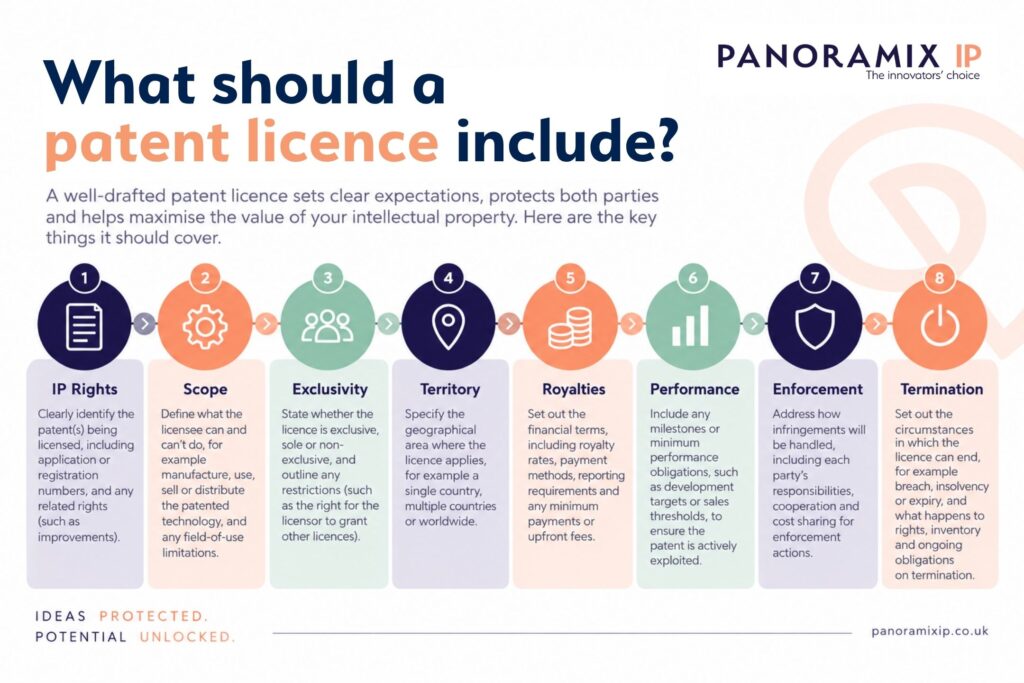
1. The patents and intellectual property being licensed
The agreement should clearly identify the patents, patent applications and associated rights covered by the licence.
This becomes particularly important where a business owns a wider patent portfolio or where further applications and improvements may arise during the relationship.
Ambiguity over what has actually been licensed can create significant problems later.
Before entering a major licensing arrangement, it may therefore be appropriate to review the strength and scope of the underlying patent protection.
2. Scope and field of use
The licence should define exactly what the licensee is permitted to do with the patented technology.
For example, rights could be limited to a particular product, industry or application.
A technology with applications in both healthcare and consumer electronics might potentially be licensed to different businesses for different fields of use.
Carefully defining these boundaries can allow the patent owner to retain valuable commercial opportunities elsewhere.
3. Territory
Patents are territorial rights, making geography particularly important.
A licence might cover the UK only, selected countries, Europe or multiple international markets, depending on the underlying patent portfolio and commercial strategy.
Where businesses intend to license technology internationally, the geographical scope of their international IP protection should therefore be considered alongside the commercial deal.
4. Royalties and payment terms
A patent licence agreement should clearly explain how the patent owner will be paid.
Depending on the deal, this could involve:
- An upfront licence fee
- Royalties based on sales
- Fixed periodic payments
- Minimum annual royalties
- Milestone payments
- A combination of different payment structures
The agreement should also establish how sales are reported, when payments become due and whether the patent owner has rights to audit relevant records.
5. Performance obligations
An exclusive licence can become commercially restrictive if the licensee then fails to exploit the technology effectively.
For that reason, agreements may include performance obligations such as minimum sales, development milestones, launch dates or minimum royalty payments.
If those targets are not achieved, the agreement might allow exclusivity to end, rights to revert to the patent owner or other agreed action to be taken.
6. Improvements and future developments
Technology rarely stands still.
If either party improves the underlying invention during the licence, who owns those improvements? Can the other party use them? Are they automatically included within the existing arrangement?
Addressing these questions at the outset can prevent uncertainty as the technology develops.
This is particularly important for innovative businesses with an ongoing R&D programme, where the technology being licensed today may look quite different in several years’ time.
7. Sublicensing
Will the licensee be permitted to grant rights to another party?
If sublicensing is permitted, the patent owner may want control over who can receive those rights, the circumstances in which sublicences can be granted and how resulting revenue is treated.
8. Confidential information
Licensing discussions frequently involve commercially sensitive information that extends beyond what is disclosed within the patent itself.
Appropriate confidentiality agreements may therefore be needed during negotiations, particularly where technical know-how, commercial information or future developments are being shared.
9. Patent infringement and enforcement
A patent licence should also establish what happens if a third party infringes the patent.
Who is responsible for identifying potential infringement? Who decides whether legal action should be taken? Who pays the costs? How are any damages or settlement proceeds divided?
These questions can become particularly important in exclusive licensing arrangements.
Having a clear approach to patent infringement and enforcement from the outset can help avoid disagreements when action needs to be taken quickly.
10. Duration and termination
Finally, the agreement needs to establish how long the licence lasts and what happens when it ends.
Termination provisions might cover circumstances such as non-payment, failure to meet agreed performance requirements, insolvency or material breach.
The consequences of termination should also be considered, particularly where products, stock, customer relationships or sublicences already exist.
Should a patent licence be registered with the UKIPO?
A patent licence can be recorded with the UK Intellectual Property Office.
Although notifying the UKIPO of the grant of a licence is not mandatory, there can be advantages to doing so and failing to register can affect certain rights.
Registration should therefore be considered as part of the wider licensing process rather than treated simply as an administrative afterthought.
Patent licensing versus selling a patent
Licensing and selling a patent are fundamentally different commercial decisions.
When a patent is assigned or sold, ownership of the relevant rights transfers to another party. When it is licensed, the patent owner retains ownership but gives somebody else permission to use those rights within agreed parameters.
For some businesses, retaining ownership while generating licensing revenue will be the more attractive option. For others, an outright sale may better support their commercial plans.
The right choice depends on the value of the IP, future opportunities, the business’s resources and its wider strategy.
Getting the commercial terms right
There is no universal patent licence agreement that works for every business.
A good licence needs to reflect the technology, patent portfolio, commercial relationship, target markets and long-term objectives of the parties involved.
That is why the negotiation of scope, exclusivity, territory, royalties and performance obligations is just as important as the legal drafting itself.
At Panoramix IP, our patent attorneys and solicitors provide patent licensing services to businesses across the UK and internationally. We can help you assess the opportunity, structure the deal and draft or negotiate a patent licence agreement designed around your commercial objectives.
Considering licensing a patent? Get in touch with Panoramix IP to discuss your options.