


If your business holds, or plans to hold, patents in Europe, you may have come across two terms that have changed the European patent landscape in recent years: the Unitary Patent (UP) and the Unified Patent Court (UPC).
Although the UK is not part of either system, both can still be highly relevant to UK businesses seeking patent protection across Europe. They offer opportunities to simplify the way patents are protected and enforced across multiple European countries, but they also introduce some important strategic considerations, particularly around how and where patent rights can be challenged.
In this guide, our international IP specialists at Panoramix IP explain what the Unitary Patent and Unified Patent Court are, how they work and what UK businesses with European patents need to consider.
What are the Unitary Patent and Unified Patent Court?
The Unitary Patent provides a single patent right covering multiple participating EU countries, while the Unified Patent Court is a specialist international court established to deal with disputes relating to Unitary Patents and certain conventional European patents across participating countries. Together, they create a more centralised approach to patent protection and enforcement within participating EU states.

Traditionally, once a European patent is granted by the European Patent Office (EPO), it effectively becomes a bundle of national patent rights. Patent owners choose the countries in which they want their patent to take effect and complete the necessary validation requirements in each.
The Unitary Patent provides an alternative. Following the grant of a qualifying European patent, the owner can request “unitary effect”, creating a single patent right covering the participating states included within that generation of the Unitary Patent system.
The Unified Patent Court complements this by providing a central court system through which relevant patents can be enforced or challenged across participating countries. This can make European patent protection and enforcement more streamlined, but centralisation works both ways. While a patent owner may be able to enforce its rights across several countries through a single action, a successful central revocation action could also result in the loss of patent protection across those countries.
What is a Unitary Patent?
A Unitary Patent, formally known as a European patent with unitary effect, provides uniform patent protection across participating EU Member States.
Businesses do not need to choose between the conventional European patent route and a Unitary Patent when first filing their application. The application and examination process takes place through the European Patent Office in the usual way. Once an eligible European patent has been granted, the patent owner can request unitary effect.
Rather than separately validating and maintaining the patent in each participating country in which protection is required, the resulting Unitary Patent operates as a single right across the countries included within its territorial scope. This can mean less administration and potentially lower costs for businesses seeking broad European patent protection, with a single request for unitary effect and one annual renewal fee paid centrally to the EPO rather than multiple renewal fees being managed separately.
However, a Unitary Patent will not necessarily be the best option in every situation. The right approach will depend on factors such as the countries in which protection is commercially important, the expected lifetime and value of the patent, the costs involved and the business’s wider European patent strategy.
Which countries does the Unitary Patent cover?
As of August 2026, Unitary Patents registered under the current territorial generation cover 18 EU Member States*: Austria, Belgium, Bulgaria, Denmark, Estonia, Finland, France, Germany, Italy, Latvia, Lithuania, Luxembourg, Malta, the Netherlands, Portugal, Romania, Slovenia and Sweden.
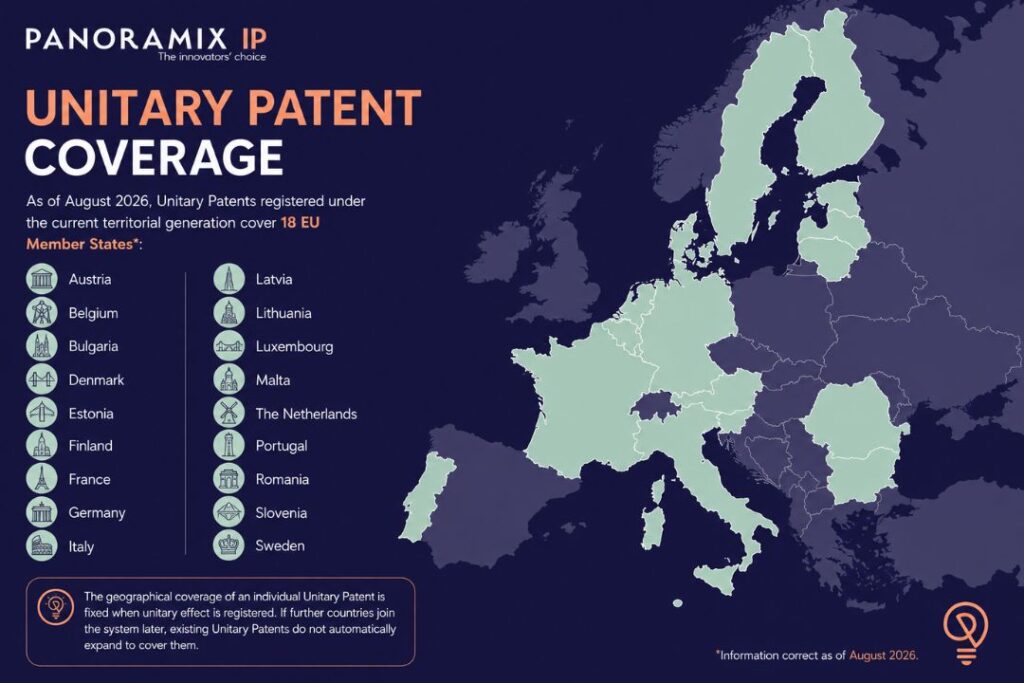
The system originally launched across 17 states on 1 June 2023, with Romania joining on 1 September 2024. It is important to understand that the geographical coverage of an individual Unitary Patent is fixed when unitary effect is registered. This means that if additional countries participate in the system in the future, existing Unitary Patents will not automatically expand to include them.
Where patent protection is required in European countries outside the Unitary Patent system, businesses may still be able to obtain protection through conventional European patent validation or other appropriate national routes.
What is the Unified Patent Court?
The Unified Patent Court (UPC) is a specialist patent court shared by participating EU Member States. It has jurisdiction over Unitary Patents and can also have jurisdiction over conventional European patents in participating states, subject to the applicable transitional arrangements and the ability to opt eligible European patents out of the UPC system.
Before the introduction of the UPC, enforcing a European patent across several countries could involve separate proceedings before different national courts. For example, infringement taking place in Germany, France and the Netherlands might require separate national actions. The UPC creates the possibility of dealing with relevant infringement and validity issues centrally, potentially allowing a patent owner to enforce its rights across several participating countries through a single action.
That centralised approach also introduces risk. A successful revocation action before the UPC can affect patent rights across the participating countries within the UPC’s jurisdiction for that patent. Whether a European patent falls within the UPC system can therefore be an important strategic consideration for patent owners.
What does the UPC mean for UK businesses?
The UK is not a participating country in either the Unitary Patent or Unified Patent Court system. UK national patents remain subject to the UK patent system, while disputes concerning those rights continue to be dealt with through the UK courts. Similarly, the UK part of a conventional European patent does not fall within the UPC’s jurisdiction.

However, this does not mean the UPC is irrelevant to UK businesses. Many UK companies hold European patents covering important markets such as Germany, France, Italy and the Netherlands, and those parts of their European patent portfolios may fall within the UPC system.
A UK business could therefore have a patent portfolio that includes UK rights outside the UPC system alongside a Unitary Patent covering participating EU states and conventional European patent validations in other countries. For UK innovators trading, manufacturing or competing across Europe, understanding how these systems interact can be an important part of managing a European patent portfolio.
What is a UPC opt-out?
One of the key decisions for owners of conventional European patents is whether to opt out of the Unified Patent Court.
During the UPC transitional period*, eligible conventional European patents can be opted out of the UPC’s jurisdiction. Where an effective opt-out is in place, disputes concerning the relevant national parts of the European patent are dealt with through the national court systems rather than centrally through the UPC.
For some patent owners, opting out can reduce the risk of a competitor bringing a single central revocation action against a commercially important patent. The trade-off is that the patent owner will also be unable to use the UPC to enforce that patent while the opt-out remains in effect.
In certain circumstances, an opt-out can be withdrawn, bringing the patent back within UPC jurisdiction. However, restrictions can apply once litigation has commenced, so it is sensible to consider the position as part of a wider patent strategy rather than waiting until a dispute arises.
When does the UPC opt-out period end?
The current transitional period began when the UPC became operational on 1 June 2023 and is initially scheduled to run for seven years, until 1 June 2030*. There is provision for the transitional period to be extended by up to a further seven years.*
The opt-out is relevant to eligible conventional European patents and applications; Unitary Patents themselves cannot be opted out of the UPC’s jurisdiction. Patent owners should therefore consider their portfolio and UPC strategy in good time, particularly where individual European patents are commercially important or may be at greater risk of challenge.
Should I opt my European patent out of the UPC?
There is no single answer that will be right for every patent or business. For some businesses, opting valuable European patents out of the UPC may be attractive because it reduces exposure to a central revocation action. For others, retaining access to the UPC’s centralised enforcement system could be commercially valuable, particularly where infringement may be taking place across several participating countries.
When considering whether to opt out, it is worth looking at factors including:
- The commercial importance of the patent: what would the impact be if protection were lost across several European markets at once?
- The likelihood of a challenge: patents in particularly competitive markets may face a greater risk of validity challenges.
- Your enforcement strategy: would the ability to pursue infringement across several countries through the UPC be useful?
- Where your competitors operate: the territories in which competitors manufacture, sell or distribute products may influence the value of UPC jurisdiction.
- Your key European markets: the commercial importance of individual countries should form part of the decision.
- The strength of the patent: the risk of central revocation may carry greater weight where validity could be contested.
- Your wider patent portfolio: different patents within the same portfolio do not necessarily need to follow the same strategy.
Ultimately, the important thing is that the decision is made deliberately and in the context of the business’s wider commercial strategy, rather than simply allowing the default position to determine how an important patent can be enforced or challenged.
If you would like support to better understand your options, and make the best decision for your business, you can speak to one of our UPC specialists at Panoramix IP. Click here to get in touch, or fill out the contact form at the bottom of this page.
Not sure whether you should opt out of the UPC?
If you hold European patents or are considering patent protection in Europe, it is worth understanding how the Unitary Patent and Unified Patent Court could affect your rights.
Talk it through with our team at Panoramix IP, in a free 45-minute IP clinic. We can look at where your patents sit, explain the practical options available and help you consider the approach that best fits your commercial objectives.
Click here to book your free 45-minute consultation or call 01522 712433.
*Information regarding participating countries, territorial coverage, the UPC transitional period and associated opt-out arrangements is correct as of August 2026. The Unitary Patent and Unified Patent Court systems continue to develop, and participating countries, deadlines and transitional arrangements may change. Up-to-date advice should be sought before making decisions relating to European patent protection or UPC opt-outs.