Receiving a cease and desist letter from Mathys & Squire can be an unsettling experience, particularly if it alleges that your business has infringed someone else’s intellectual property (IP) rights.
Your first instinct may be to ignore it, respond immediately, or assume you’ve done something wrong. However, none of these are likely to be the best course of action.
The important thing is to understand what the letter means, what rights are being asserted, and what options are available to you before taking any action. This is where our friendly and approachable IP lawyers are here to help you.
In this guide, our IP specialists explain why you may have received a letter from Mathys & Squire, what you should do next, and how specialist intellectual property advice can help.
Who Are Mathys & Squire?
Mathys & Squire is one of the UK’s longest-established intellectual property firms, founded in 1910. Its team of patent, trade mark and design attorneys advises businesses, research institutions and global brands on protecting and enforcing their intellectual property rights.
The firm has its head office in London, with further UK offices in Birmingham, Cambridge, Manchester, Newcastle and Oxford, and an international presence spanning Europe and Asia. It handles the full range of IP work, including patents, trade marks, registered designs and copyright, both contentious and non-contentious.
It’s important to remember that the letter has been sent on behalf of a rights holder. Receiving one does not automatically mean you have infringed their rights, but it does mean the allegation should be taken seriously.
Why Have I Received a Letter from Mathys & Squire?
There are many reasons why Mathys & Squire may contact a business or individual.
The letter may ask you to stop using a business name or logo, remove products from sale, change branding, transfer a domain name, provide information about your activities, or sign legal undertakings. Exactly what is being requested will depend on the circumstances and the intellectual property rights involved.
What Should You Do If You Receive a Letter from Mathys & Squire?
Although receiving legal correspondence can feel daunting, it is important not to panic or respond hastily. Before taking any action, you should:
Read the letter carefully and make sure you understand what is being alleged.
Identify the intellectual property rights being relied upon.
Keep copies of the letter and any related correspondence or documents.
Avoid admitting liability, making commitments or agreeing to anything before seeking advice.
Speak to an experienced intellectual property professional at Panoramix IP.
Every intellectual property dispute is different. The claims made against you may have merit, but there may also be grounds to challenge the allegations, defend your position or reach a commercially sensible resolution. Taking the time to understand the strength of the claim and your available options before responding can help you decide on the most appropriate course of action.
Should You Ignore a Letter from Mathys & Squire?
It is important not to ignore a letter from Mathys & Squire.
Failing to respond to correspondence concerning intellectual property rights could cause the matter to escalate and, if a resolution cannot be reached, the rights holder may choose to take further legal action.
However, receiving a letter does not necessarily mean that court proceedings will follow. Many intellectual property disputes can be resolved through discussion and negotiation once both parties have a clearer understanding of their respective legal and commercial positions.
Seeking specialist advice at an early stage can help you understand your options, prepare an appropriate response and potentially resolve the dispute before it becomes more costly or disruptive.
How To Respond To a Cease and Desist Letter From Mathys & Squire
If you have received a letter from Mathys & Squire, or another intellectual property law firm, seeking independent advice from an IP specialist at Panoramix IP can help you understand your legal position, assess the potential impact on your business and make an informed decision about how to respond.
At Panoramix IP, our team brings together UK Chartered Trade Mark Attorneys, European Trade Mark Attorneys, US Trade Mark Attorneys, UK Chartered Patent Attorneys, European Patent Attorneys and dual-qualified IP solicitors. We regularly support businesses facing allegations of intellectual property infringement, providing straightforward, commercially focused advice based on the individual circumstances of each case.
Depending on your situation, we can:
Review the allegations and correspondence you have received.
Assess the validity and strength of the intellectual property rights being relied upon.
Advise on whether infringement may have occurred.
Prepare or review a response on your behalf.
Communicate and negotiate with the other party.
Explore options for resolving the dispute efficiently while protecting your commercial interests.
Our role goes beyond explaining the legal position. We work with you to understand the wider commercial context, consider the options available and help you work towards the most appropriate outcome for your business.
If you would like our support in responding to a cease and desist letter, or would like our representation, please get in touch with our team today. You can do so by calling us on 01522 712433, emailing info@panoramixip.co.uk, or completing the contact form below.
Receiving a cease and desist letter from Marks & Clerk can be an unsettling experience, particularly if it alleges that your business has infringed someone else’s intellectual property (IP) rights.
Your first instinct may be to ignore it, respond immediately, or assume you’ve done something wrong. However, none of these are likely to be the best course of action.
The important thing is to understand what the letter means, what rights are being asserted, and what options are available to you before taking any action. This is where our friendly and approachable IP lawyers are here to help you.
In this guide, our UK IP firm explain why you may have received a letter from Marks & Clerk, what you should do next, and how specialist intellectual property advice can help.
Who Are Marks & Clerk?
Marks & Clerk is one of the UK’s largest intellectual property firms, with offices across the UK and around the world. They advise businesses, universities and global brands on protecting and enforcing intellectual property rights, including trade marks, patents, registered designs and copyright.
If you’ve received correspondence from Marks & Clerk, it is likely because they are acting on behalf of one of their clients who believes their intellectual property rights have been infringed.
It’s important to remember that the letter has been sent on behalf of a rights holder. Receiving one does not automatically mean you have infringed their rights, but it does mean the allegation should be taken seriously.
Why Have I Received a Letter from Marks & Clerk?
There are many reasons why Marks & Clerk may contact a business or individual.
The letter may ask you to stop using a business name or logo, remove products from sale, change branding, transfer a domain name, provide information about your activities, or sign legal undertakings.
Exactly what is being requested will depend on the circumstances and the intellectual property rights involved.
What Should You Do If You Receive a Letter from Marks & Clerk?
Although receiving legal correspondence can feel intimidating, the most important thing is to remain calm and avoid making rushed decisions.
Before responding, you should:
Read the letter carefully.
Identify exactly what rights are being relied upon.
Keep copies of all correspondence.
Avoid admitting liability or making promises before obtaining advice.
Seek advice from an experienced intellectual property professional at Panoramix IP.
Every dispute is different. In some cases, the allegations may be well founded. In others, there may be valid arguments available to defend your position or negotiate a practical commercial solution.
Understanding the strength of the claim before responding can make a significant difference to the outcome.
Should You Ignore a Letter from Marks & Clerk?
You should not ignore a letter from Marks and Clerk.
Ignoring correspondence relating to intellectual property rights can allow the dispute to escalate unnecessarily. If the matter cannot be resolved, the rights holder may decide to pursue legal proceedings.
That does not mean court action is inevitable. Many intellectual property disputes are resolved through negotiation once both parties have had the opportunity to understand the legal and commercial position.
Responding appropriately – and with the benefit of specialist advice – can often help avoid unnecessary cost and disruption.
How To Respond To a Cease and Desist Letter From Marks & Clerk
If you’ve received a letter from Marks & Clerk (or another IP law firm), obtaining independent advice from an IP specialist at Panoramix can help you understand both the legal position and the commercial implications before deciding how to respond.
At Panoramix IP, our team includes UK Chartered Trade Mark Attorneys, European Trade Mark Attorneys, US Trade Mark Attorneys, UK Chartered Patent Attorneys, European Patent Attorneys and dual-qualified IP solicitors.
We regularly advise businesses that have received allegations of intellectual property infringement and can provide clear, practical guidance tailored to your situation.
Depending on the circumstances, we can:
Review the allegations made against you.
Assess the validity and strength of the intellectual property rights being relied upon.
Explain whether infringement is likely to have occurred.
Prepare or review your response.
Negotiate with the other party on your behalf.
Help you resolve the dispute as efficiently and commercially as possible.
Our aim is not simply to explain the law, but to help you reach the best outcome for your business.
If you would like our support in responding to a cease and desist letter, or would like our representation, please get in touch with our team today. You can do so by calling us on 01522 712433, emailing info@panoramixip.co.uk, or completing the contact form below.
Discovering that someone else has registered a domain name using your registered trade mark can be frustrating, particularly if they’re using it to sell similar products, divert customers or simply prevent you from using your own brand online.
While owning a registered trade mark does not automatically give you ownership of every matching domain name, it can provide you with strong legal grounds to challenge the registration or use of that domain in certain circumstances.
In this guide, our Nottinghamshire IP Lawyers will explain your rights, the options available to you, and how to resolve a domain name dispute.
Does Owning a Trade Mark Automatically Give You the Domain Name?
No. Registering a trade mark does not automatically give you ownership of the matching domain name.
A trade mark and a domain name are two separate rights that must each be obtained independently. Registering your business name as a trade mark does not reserve the corresponding website address, and purchasing a domain name does not give you ownership of the trade mark.
For example, you could successfully register the trade mark Bills Coffee, only to discover that billscoffee.co.uk or billscoffee.com has already been registered by someone else. Equally, someone may own a domain name without having any registered trade mark rights.
This is why it’s important to secure both your trade mark and your preferred domain name as early as possible when launching a new brand.
When Could a Domain Name Infringe Your Trade Mark?
If someone else owns the domain name that matches your registered trade mark, this does not automatically mean that they are committing infringement.
However, you may have grounds to take action if the domain:
Is identical or confusingly similar to your registered trade mark.
Is being used in connection with similar goods or services.
Is likely to mislead customers into believing there is an association with your business.
Takes unfair advantage of your brand’s reputation.
Damages the distinctive character or reputation of your trade mark.
For example, if your registered trade mark is Bills Coffee, and someone registers billscoffee.co.uk to sell competing coffee products, this could potentially infringe your trade mark rights.
An experienced domain name IP lawyer can assess your position, advise whether you have a potential claim, and advise on the most appropriate course of action. We’d recommend booking a free 45-minute consultation with one of our specialists at Panoramix IP, who can support with your next steps.
What If Someone’s Using My Trade Mark In a Domain That Isn’t In Use?
Sometimes you’ll discover that the domain simply displays a holding page, advertisements or a message stating that it is for sale.
Even if the domain is inactive, you may still have options.
In some cases, registering a domain primarily to prevent the legitimate trade mark owner from using it, or to sell it back for profit, may be considered evidence of bad faith.
Inactive domains can therefore still become the subject of a successful domain name dispute, depending on the circumstances.
What Is Cybersquatting?
Cybersquatting is the practice of registering a domain name that incorporates another person’s trade mark or brand with the intention of benefiting from their reputation.
Common examples include:
Registering a well-known business name before the genuine owner can.
Purchasing domains that closely resemble established brands.
Registering common misspellings of popular websites (known as typosquatting).
Attempting to sell the domain back to the trade mark owner for an inflated price.
Using the domain to divert customers to a competing business.
Cybersquatting is a common cause of domain name disputes, and there are established procedures available to challenge these registrations.
If you believe someone is cybersquatting on your brand or domain name, our experienced domain name lawyers are here to help. Get in touch with a member of our team today!
How Can You Recover a Domain Name?
If someone has registered a domain name that infringes your trade mark rights or has been registered in bad faith, you may be able to challenge the registration and recover the domain. The most appropriate course of action will depend on factors such as the domain extension, the circumstances of the registration and the evidence available.
For .uk and .co.uk domain names, disputes can often be resolved through Nominet’s Dispute Resolution Service (DRS), while disputes involving .com, .net, .org and many other international domain extensions are typically handled under the Uniform Domain Name Dispute Resolution Policy (UDRP).
Navigating these procedures can be complex, particularly where trade mark rights, allegations of bad faith or competing claims to a domain name are involved. Seeking specialist legal advice at an early stage can significantly improve your chances of reaching a successful outcome.
At Panoramix IP, our experienced domain name dispute lawyers regularly advise businesses on recovering domain names, defending against disputes and protecting valuable brands online. We’ll assess the strength of your case, explain the options available and guide you through the most appropriate dispute resolution process, helping you protect your intellectual property with confidence.
What Evidence Can Help With A Domain Name Dispute?
When disputing a domain name, the stronger your evidence, the stronger your position.
Useful evidence may include:
Your registered trade mark certificate.
Evidence showing when you first started using your brand.
Screenshots of the website using the disputed domain.
Examples of customer confusion.
Marketing materials demonstrating your reputation.
Correspondence with the domain owner.
Evidence suggesting the domain was registered in bad faith.
Collecting evidence early can help support any negotiations or formal dispute proceedings. At Panoramix IP, we support domain name dispute claimants to collect the necessary evidence for a successful claim.
How to Protect Your Brand Online
While domain name disputes cannot always be avoided, there are several steps you can take to reduce the risk:
Register your trade mark as early as possible (We now offer quick and easy online filing service for UK and US trade marks!)
Secure the main domain extensions for your business, including .co.uk, .uk and .com where appropriate.
Register common spelling variations of your brand.
Monitor new domain registrations that may affect your business.
Consider international trade mark protection if you operate overseas or plan to expand.
Taking a proactive approach to brand protection is often far less costly than resolving a dispute later.
Get Help with a Domain Name Dispute
If someone has registered or is using a domain name that incorporates your trade mark, don’t wait to take action. We can help!
At Panoramix IP, our experienced domain name dispute lawyers advise businesses of all sizes on trade mark infringement, domain name disputes and brand protection strategies. We can assess your legal position, explain the options available and help you pursue the most effective resolution for your circumstances.
If you’re concerned that someone is using your trade mark as their domain name, get in touch with our team today to discuss your options.
In 2021, Marks & Spencer launched legal action against Aldi over the now-famous Colin the Caterpillar and Cuthbert the Caterpillar cakes, and the story quickly became national news. The case sparked widespread debate, with many questioning whether Aldi had gone too far in creating a similar product, or whether Marks & Spencer had overreacted. Public opinion was divided, and many people rallied behind Aldi, with several other supermarkets even joining the conversation on social media to show their support for Cuthbert in a light-hearted display of brand banter.
While the dispute captured public attention thanks to its light-hearted subject matter, it also highlighted an important area of UK intellectual property law that many businesses know little about: passing off.
Unlike trade mark infringement, a passing off claim does not necessarily rely on having a registered trade mark. Instead, it protects the goodwill and reputation that a business has built over time, preventing competitors from misleading consumers into believing their products or services are associated with another brand.
For businesses of all sizes, understanding passing off claims is essential. Whether you’re launching a new product, growing an established brand, or concerned that another business is benefiting from your reputation, knowing your legal rights can help you protect the value you’ve worked hard to build.
In this guide, our UK and international passing off specialists explain what a passing off claim is, explore the Colin vs Cuthbert dispute as a real-world example, help you understand whether you may have grounds to bring a passing off claim, and outline the steps you can take if another business is attempting to pass off its products or services as your own.
What Is a Passing Off Claim?
A passing off claim is a common law legal action that enables a business to protect its brand against another party that misrepresents its goods or services, leading consumers to believe there is a commercial connection between the two businesses.
Passing off protects businesses that have developed a valuable reputation through trading, even where certain elements of their brand may not be formally registered. In practice, a passing off claim often arises where another business adopts branding, packaging, product names or other distinguishing features that are sufficiently similar to create confusion in the marketplace.
It’s important to note that simply creating a similar product is not automatically passing off. Competition is perfectly lawful. The issue arises where similarities are likely to mislead consumers into believing there is some form of commercial connection between the two businesses.
For this reason, passing off claims often involve careful consideration of consumer perception, branding, marketing and the overall impression created by the products or services in question.
What Are The Three Elements of a Passing Off Claim?
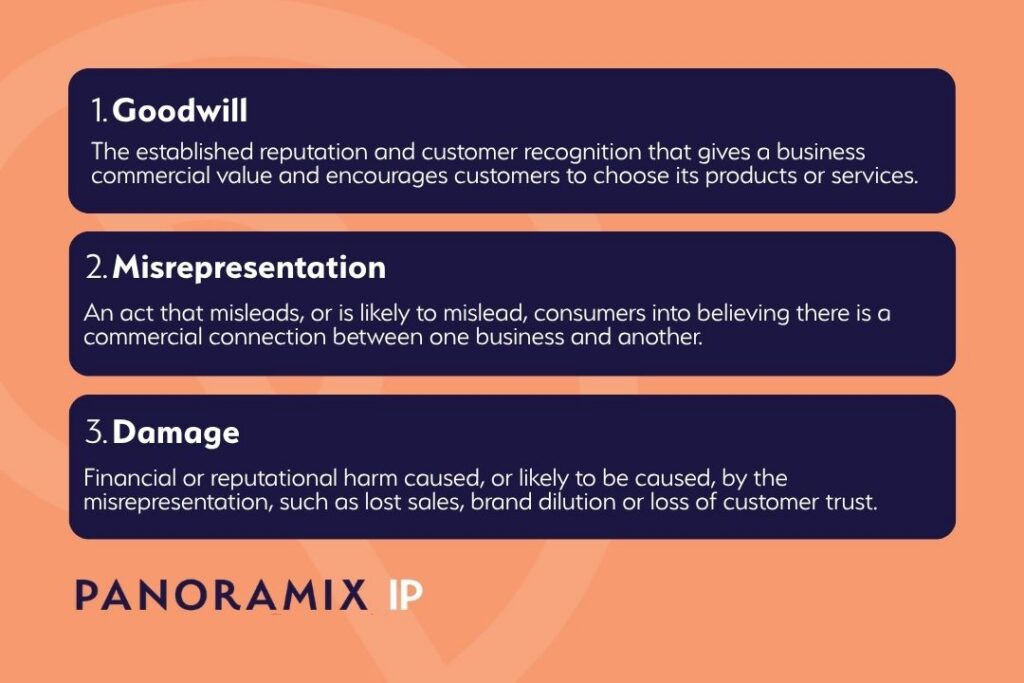
To succeed in a passing off claim, the claimant must satisfy three key legal elements, commonly known as the ‘classical trinity’. This formulation of passing off was set out by Lord Oliver of Aylmerton in the House of Lords, in 1990 (Gov.uk, 2026).
The three elements for passing off claims are:
1. Goodwill
The first requirement in the classical trinity is establishing goodwill.
Goodwill refers to the reputation a business has built with its customers. It represents the commercial value attached to a brand through factors such as customer loyalty, recognition and trust.
What evidence can be used to demonstrate goodwill in a passing off claim?
Evidence used to demonstrate goodwill could include:
Sales figures
Length of time trading
Marketing and advertising activity
Customer testimonials
Press coverage
Social media presence
Market share
Without goodwill, there is generally nothing for the law of passing off to protect.
2. Misrepresentation
The second element is misrepresentation.
Misrepresentation does not require deliberate deception or outrightly acting as another brand, business, or product. Instead, the courts consider whether the defendant’s actions are likely to lead consumers to believe that their goods or services are connected with the claimant’s business.
What could count as a misrepresentation in a passing off claim?
Things that could be classed as misrepresentation include:
Similar product packaging
Similar brand names
Comparable logos or branding
Product shapes or presentation
Marketing that creates a misleading association
The key question is whether the average consumer is likely to be confused.
Even if customers eventually realise the products come from different businesses, initial confusion may still be relevant when assessing whether passing off has occurred.
3. Damage
Finally, to be able to make a successful passing off claim, the claimant must demonstrate that the misrepresentation has caused, or is likely to cause, damage to their goodwill.
Alleged damage from passing off may include:
Lost sales
Damage to reputation
Brand dilution
Loss of exclusivity
Reduced consumer confidence
In some cases, the mere risk of damage may be sufficient, particularly where an established brand has invested significant time and resources into developing its reputation.
Together, these three elements – goodwill, misrepresentation and damage – form the legal foundation of every successful passing off claim.
Colin vs Cuthbert: An Example of a Passing Off Claim
The infamous dispute between Marks & Spencer‘s Colin the Caterpillar and Aldi‘s Cuthbert the Caterpillar is perhaps one of the UK’s most recognisable examples of a passing off claim.
Originally launched by Marks & Spencer in 1990, Colin the Caterpillar has become well recognised. Over the years, Colin the Caterpillar cake has developed a strong reputation with consumers, becoming synonymous with birthdays, celebrations and family occasions. M&S has since expanded the Colin brand into a wider product range, including soft toys, confectionery, tableware, and more, reinforcing its recognition and commercial value.
Pictured: A generic, unbranded caterpillar cake.
In 2021, Marks & Spencer brought legal proceedings against Aldi, alleging that Aldi’s Cuthbert the Caterpillar cake infringed its intellectual property rights. M&S wanted Aldi to remove the product from sale and agree not to sell anything similar in the future (BBC News, 2021). Alongside claims relating to registered trade marks, M&S also relied on the law of passing off.
At the heart of the passing off claim was the argument that Colin had built substantial goodwill over several decades, and that similarities between the two products could lead consumers to believe there was an association between them.
Although the cakes featured different names, there were a number of similarities that attracted attention, including:
Comparable caterpillar-shaped chocolate cakes.
Similar facial features and decorative elements.
Similar packaging presentation.
Positioning as celebration cakes for similar occasions.
Ultimately, in 2022, the case was settled privately between the parties, meaning the courts never reached a final decision on whether passing off had occurred (Sky News, 2022).
However, the dispute remains a valuable example of passing off because it demonstrates the types of factors that are considered when assessing a passing off claim. It wasn’t just about whether two cakes looked alike. The legal question centred on whether M&S had established goodwill, whether Aldi’s product amounted to a misrepresentation, and whether that was likely to damage the Colin brand.
The Difference Between Passing Off and Trade Mark Infringement
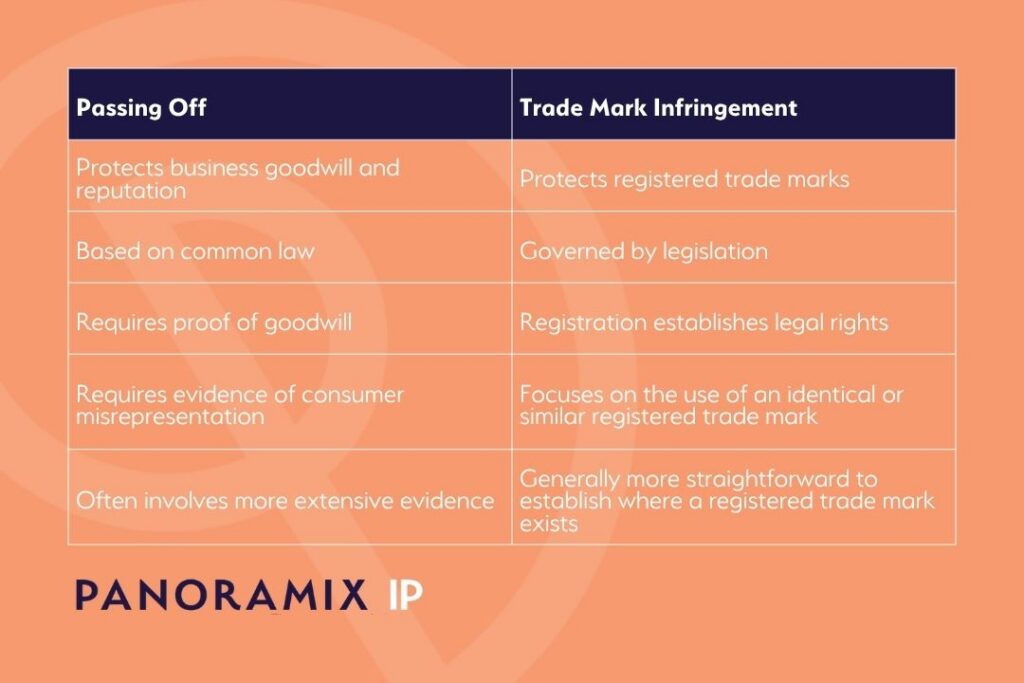
Whilst passing off and trade mark infringement are often mentioned together, they are separate legal causes of action with different requirements. Both are designed to protect brands, but they do so in different ways. The graphic below explains how.
One of the biggest differences is that a trade mark registration gives businesses an exclusive legal right to use that mark in relation to the goods or services it covers.
With passing off, there is no automatic right. Instead, businesses must prove that they have built sufficient goodwill and that another party’s actions are causing, or are likely to cause, consumer confusion and commercial damage.
This is one of the reasons why registering your trade marks at an early stage can be so valuable. Registration provides a stronger legal foundation for enforcing your rights and may reduce the evidential burden if a dispute arises in the future.
That said, passing off remains an important legal remedy, particularly where valuable goodwill extends beyond the scope of registered trade marks or where elements of a brand have not been formally protected.
Can I Make a Passing Off Claim?
If another business is using branding, packaging or marketing that appears similar to yours, you might have grounds to bring a passing off claim.
For example, if…
Your business has developed a recognised reputation or goodwill.
Another business is presenting its goods or services in a way that could mislead consumers.
Customers have confused the two businesses, or there is a real likelihood of confusion.
Your business has suffered, or is likely to suffer, financial or reputational damage as a result.
However, businesses are entitled to compete, and many products within the same market naturally share certain characteristics. When a passing off claim is made, courts will look at the overall impression created, the reputation of the original business, and whether consumers are genuinely likely to be misled.
This is why obtaining specialist legal advice on passing off is so important. One of Panoramix’s experienced intellectual property professionals can assess the strength of your position, review the available evidence, and advise on the most appropriate course of action before matters escalate.
Equally, if you’re developing a new brand or product, seeking advice before launch can help identify potential risks and reduce the likelihood of infringing another business’s intellectual property rights.
At Panoramix IP, we offer a free30-minute IP consultation, where we can offer advice on your situation, and advise on whether we believe you may have grounds for a successful passing off claim.
How Do I Make a Passing Off Claim?
If you believe another business is unfairly benefiting from your brand’s reputation, it’s important to act promptly. While every dispute is different, the process of making a passing off claim typically involves gathering evidence, assessing the legal position and, where appropriate, taking action to protect your rights.
1. Establish Your Goodwill
The first step is demonstrating that your business has built goodwill in relation to the relevant products or services.
Evidence may include:
Trading history.
Sales figures.
Marketing and advertising campaigns.
Customer reviews and testimonials.
Website traffic and social media engagement.
Press coverage and industry recognition.
The stronger the evidence of your reputation, the stronger the foundation of your passing off claim is likely to be.
2. Gather Evidence of Misrepresentation
Next, you’ll need to consider whether another business is making a representation that is likely to confuse consumers.
Useful evidence might include:
Photographs of competing products.
Examples of similar branding or packaging.
Marketing materials.
Customer enquiries demonstrating confusion.
Social media comments or reviews.
Correspondence from distributors or retailers.
It’s important to remember that actual confusion is not always required. In many cases, evidence that consumers are likely to be misled may be sufficient.
3. Demonstrate Damage
You’ll also need to consider how the alleged misrepresentation has affected your business.
Claims of damage may include:
Lost sales.
Damage to your brand’s reputation.
Loss of licensing opportunities.
Reduced exclusivity within the market.
Harm to customer trust.
In some circumstances, the likelihood of future damage may also be relevant.
4. Seek Specialist Intellectual Property Advice
Passing off claims can be legally and evidentially complex. At Panoramix IP, our top passing off lawyers help businesses protect their brands through practical, commercially focused intellectual property advice. From trade mark protection and brand strategy to passing off claims and dispute resolution, our experienced team can help you understand your options and take the most appropriate next steps.
Depending on the circumstances, these may include:
Reviewing the available evidence, or gathering evidence.
Advising on the prospects of success.
Preparing and sending a letter before action.
Exploring settlement or alternative dispute resolution.
Commencing court proceedings where necessary.
Equally, if allegations of passing off have been made against your business, obtaining early advice from our top rated passing off lawyers can help you assess your options and respond appropriately.
If you’d like to discuss a potential passing off claim or any other intellectual property matter, get in touch with our passing off lawyers for tailored advice.
Receiving a cease and desist letter from Wilson Gunn can be concerning, particularly if it claims that your business has infringed another party’s intellectual property (IP) rights.
You may feel under pressure to respond immediately, be tempted to ignore the letter, or assume that the allegations must be correct. However, taking action before you fully understand the situation may not be the best approach.
It is important to establish what is being alleged, which intellectual property rights are being asserted and what options are available to you before deciding how to proceed. Our friendly and approachable IP lawyers can help you understand the correspondence, assess your position and determine the most appropriate next steps.
In this guide, our IP dispute resolution consultants explain why you may have received a letter from Wilson Gunn, what to consider before responding, and how specialist intellectual property advice can help you navigate the dispute.
Who Are Wilson Gunn?
Wilson Gunn is a long-established firm of patent and trade mark attorneys, founded in Manchester in 1864 and with more than 160 years of history. Its head office remains in Manchester, with further UK offices in Birmingham, Chesterfield, Liverpool, London and Glasgow.
The firm handles all of the main areas of intellectual property, including patents, trade marks, registered designs and copyright. If you have received correspondence from Wilson Gunn, it is likely because they are acting for a rights holder who believes their intellectual property is being infringed.
It’s important to remember that the letter has been sent on behalf of a rights holder. Receiving one does not automatically mean you have infringed their rights, but it does mean the allegation should be taken seriously.
Why Have I Received a Letter from Wilson Gunn?
There are several reasons why Wilson Gunn may contact a business or individual, often in relation to a potential intellectual property dispute. The allegations could involve:
Depending on the nature of the issue, the correspondence may ask you to stop using a particular business name, trade mark or logo, withdraw products from sale, make changes to your branding, transfer a domain name, provide details about your activities, or agree to certain legal undertakings.
The action requested will depend on the intellectual property rights being asserted, the nature of the alleged infringement and the specific circumstances surrounding the dispute.
What Should You Do If You Receive a Letter from Wilson Gunn?
Receiving legal correspondence can be worrying, but it is important to take a considered approach rather than reacting too quickly.
Before responding, you should:
Read the letter carefully and make sure you understand the allegations being made.
Identify the intellectual property rights the other party is relying upon.
Keep copies of the letter and any related correspondence or supporting documents.
Avoid admitting liability, agreeing to demands or making commitments before seeking professional advice.
Speak to an experienced intellectual property professional at Panoramix IP.
Every intellectual property dispute is different. Some claims may have a strong legal basis, while others may be open to challenge or leave room for negotiation. Understanding the strength of the allegations, your own position and the options available to you can help you decide on the most appropriate response and work towards a practical commercial resolution.
Should You Ignore a Letter from Wilson Gunn?
A letter from Wilson Gunn should not be ignored, even if you do not agree with the allegations being made.
Failing to respond to correspondence about intellectual property rights could lead to the dispute escalating. If the issue remains unresolved, the rights holder may decide to take further action, which could include formal legal proceedings.
However, receiving a letter does not necessarily mean that the matter will end up in court. Many intellectual property disputes are resolved through discussion or negotiation between the parties. Seeking specialist advice at an early stage can help you understand your position, respond appropriately and explore potential solutions while reducing unnecessary costs and disruption to your business.
How To Respond To a Cease and Desist Letter From Wilson Gunn
If you have received a letter from Wilson Gunn, or another intellectual property law firm, seeking independent advice from an IP specialist at Panoramix IP can help you understand the allegations, clarify your legal position and consider the potential commercial impact before deciding how to respond.
At Panoramix IP, our team includes UK Chartered Trade Mark Attorneys, European Trade Mark Attorneys, US Trade Mark Attorneys, UK Chartered Patent Attorneys, European Patent Attorneys and dual-qualified IP solicitors. We regularly support businesses facing allegations of intellectual property infringement, providing practical, commercially focused advice tailored to the particular circumstances of the dispute.
Depending on the issues involved, we can:
Review the correspondence and allegations made against you.
Examine the validity and strength of the intellectual property rights being asserted.
Advise on whether infringement may have occurred.
Draft or review your response.
Communicate and negotiate with the other party on your behalf.
Explore practical options for resolving the dispute while protecting your commercial interests.
Our role goes beyond explaining the legal position. We consider the wider impact on your business, helping you understand your options, make informed decisions and work towards a practical and commercially appropriate resolution.
If you would like our support in responding to a cease and desist letter, or would like our representation, please get in touch with our team today. You can do so by calling us on 01522 712433, emailing info@panoramixip.co.uk, or completing the contact form.
Receiving a cease and desist letter from Stobbs can be concerning, particularly when it alleges that your business has infringed another party’s intellectual property (IP) rights.
You may feel the need to respond immediately, choose to ignore the correspondence, or assume that the allegations must be valid. However, taking any action before fully understanding the situation may not be in your best interests.
Before responding, it is important to establish what is being alleged, which intellectual property rights are being asserted and what options are open to you. Our friendly and approachable IP lawyers can help you understand the correspondence, assess your position and determine the most appropriate next steps.
In this guide, our UK IP team explores why you may have received a letter from Stobbs, what you should consider before responding, and how specialist intellectual property advice can help you manage the situation.
Who Are Stobbs?
Stobbs is a specialist intellectual property firm that focuses on brands and intangible assets rather than patents. Established in 2013 and based near Cambridge, it has built a substantial team advising well-known consumer and technology brands.
The firm’s work centres on trade marks, brand strategy, licensing, dispute resolution, anti-counterfeiting and online brand enforcement. Because of this focus, a letter from Stobbs will most often concern the use of a brand name, logo or other trade mark rather than a patent.
It’s important to remember that the letter has been sent on behalf of a rights holder. Receiving one does not automatically mean you have infringed their rights, but it does mean the allegation should be taken seriously.
Why Have I Received a Letter from Stobbs?
There are several reasons why Stobbs may contact an individual or business, often in connection with a potential intellectual property dispute. The allegations may involve:
Depending on the nature of the dispute, the correspondence may ask you to stop using a particular name, trade mark or logo, withdraw certain products from sale, amend your branding, transfer a domain name, provide information about your business activities, or enter into legal undertakings.
The specific action being requested will vary from case to case and will depend on the rights being asserted, the nature of the alleged infringement and the wider circumstances surrounding the dispute.
What Should You Do If You Receive a Letter from Stobbs?
Receiving legal correspondence can be worrying, but it is important to consider the situation carefully before responding or agreeing to anything. As a first step, you should:
Read the letter thoroughly and make sure you understand the allegations being made.
Establish which intellectual property rights the other party is relying upon.
Keep copies of the letter and any other relevant correspondence or documentation.
Avoid admitting liability, accepting demands or making commitments until you have obtained professional advice.
Seek guidance from an experienced intellectual property professional at Panoramix IP.
Every intellectual property dispute has its own circumstances, and the claims made in a letter should be considered carefully. Some allegations may be supported by enforceable rights, while others may be open to challenge or provide scope for negotiation. Assessing the strength of the claim and understanding your own position can help you decide how best to respond and work towards a commercially sensible resolution.
Should You Ignore a Letter from Stobbs?
A letter from Stobbs should be taken seriously and should not be left unanswered.
Failing to engage with correspondence concerning intellectual property rights could lead to the dispute progressing further. If the issue remains unresolved, the rights holder may decide to consider formal legal proceedings.
However, receiving such a letter does not automatically mean that the matter will end up in court. Many intellectual property disputes are settled through communication and negotiation before litigation becomes necessary. Obtaining specialist advice and responding in a considered way can help you explore possible solutions, protect your position and reduce the risk of unnecessary costs and disruption to your business.
How To Respond To a Cease and Desist Letter From Stobbs
If you have received a letter from Stobbs, or another intellectual property law firm, seeking independent advice from an IP specialist at Panoramix IP can help you understand the allegations, evaluate your legal position and consider the wider commercial implications before deciding how to proceed.
At Panoramix IP, our team includes UK Chartered Trade Mark Attorneys, European Trade Mark Attorneys, US Trade Mark Attorneys, UK Chartered Patent Attorneys, European Patent Attorneys and dual-qualified IP solicitors. We regularly support businesses dealing with allegations of intellectual property infringement, providing straightforward, practical advice that takes both legal and commercial considerations into account.
Depending on the circumstances of your dispute, we can:
Analyse the allegations and correspondence you have received.
Consider the validity and strength of the intellectual property rights being asserted.
Advise on whether infringement may have taken place.
Draft or review a response on your behalf.
Manage communications and negotiations with the other party.
Explore practical options for resolving the dispute efficiently and protecting your commercial interests.
Our role is not simply to advise you on what the law says. We take the time to understand your business, priorities and the potential impact of the dispute, helping you make informed decisions and work towards the most appropriate outcome.
If you would like our support in responding to a cease and desist letter, or would like our representation, please get in touch with our team today. You can do so by calling us on 01522 712433, emailing info@panoramixip.co.uk, or completing the contact form.
Receiving a cease and desist letter from Appleyard Lees can be concerning, particularly if it alleges that your business has infringed another party’s IP rights.
You may feel pressured to respond immediately, be tempted to ignore the correspondence, or assume that the allegations must be correct. However, it is important to understand exactly what is being claimed before deciding what to do next.
This means looking carefully at the allegations, identifying the intellectual property rights being asserted and considering the options available to you. Our friendly and approachable IP lawyers can help you understand your position and determine the most appropriate way forward.
In this guide, our UK IP dispute resolution specialists explain why you may have received a letter from Appleyard Lees, the steps you should consider before responding, and how specialist intellectual property advice can help you navigate the dispute.
Who Are Appleyard Lees?
Appleyard Lees is a leading UK intellectual property firm of patent and trade mark attorneys, supported by specialist IP solicitors and litigators. It has offices in Cambridge, Leeds, Halifax, Manchester and London.
The firm advises on patents, trade marks, registered designs and copyright, with technical strengths across engineering, electronics and software, chemistry and pharmaceuticals, and life sciences. A letter from Appleyard Lees is generally sent on behalf of a client who believes their IP rights have been infringed.
It’s important to remember that the letter has been sent on behalf of a rights holder. Receiving one does not automatically mean you have infringed their rights, but it does mean the allegation should be taken seriously.
Why Have I Received a Letter from Appleyard Lees?
There are a number of reasons why Appleyard Lees may contact a business or individual, typically in connection with an intellectual property concern or dispute. The allegations may relate to:
Depending on the issue involved, the letter may ask you to stop using a particular business name, brand or logo, withdraw certain products from sale, alter your branding, transfer a domain name, disclose information about your activities, or agree to specific legal undertakings.
The requests made will vary depending on the intellectual property rights being relied upon, the nature of the alleged infringement and the individual circumstances of the dispute.
What Should You Do If You Receive a Letter from Appleyard Lees?
Receiving legal correspondence can feel daunting, but it is important to take a measured approach and avoid responding before you fully understand the situation.
Before taking any action, you should:
Read the letter carefully.
Identify exactly what rights are being relied upon.
Keep copies of all correspondence.
Avoid admitting liability or making promises before obtaining advice.
Seek advice from an experienced intellectual property professional at Panoramix IP.
Every intellectual property dispute is different. Some allegations may be well supported, while others may be open to challenge or leave room for negotiation. Understanding the strength of the claim, your own legal position and the options available to you can help you decide on the most appropriate response and work towards a practical commercial outcome.
Should You Ignore a Letter from Appleyard Lees?
A letter from Appleyard Lees should not be ignored, even if you are unsure whether the allegations being made are justified.
Failing to respond to correspondence concerning intellectual property rights could result in the matter progressing further. If the dispute remains unresolved, the rights holder may decide to consider formal legal action.
However, receiving a letter does not necessarily mean that court proceedings will follow. Many intellectual property disputes are resolved through discussion and negotiation, without the need for litigation. Seeking specialist advice and responding in a considered way can help you understand your options, protect your position and potentially resolve the matter before it becomes more costly or disruptive.
How To Respond To a Cease and Desist Letter From Appleyard Lees
If you have received a letter from Appleyard Lees, or another intellectual property law firm, getting independent advice from an IP specialist at Panoramix IP can help you understand the claims being made, your legal position and the possible commercial consequences before deciding how best to respond.
At Panoramix IP, our team includes UK Chartered Trade Mark Attorneys, European Trade Mark Attorneys, US Trade Mark Attorneys, UK Chartered Patent Attorneys, European Patent Attorneys and dual-qualified IP solicitors. We regularly assist businesses dealing with allegations of intellectual property infringement, providing clear, practical advice that considers both the legal issues and the wider needs of your business.
Depending on the circumstances, we can:
Review the allegations made against you.
Assess the validity and strength of the intellectual property rights being relied upon.
Explain whether infringement is likely to have occurred.
Prepare or review your response.
Negotiate with the other party on your behalf.
Help you resolve the dispute as efficiently and commercially as possible.
Our aim is not simply to explain the law, but to help you reach the best outcome for your business.
If you would like our support in responding to a cease and desist letter, or would like our representation, please get in touch with our team today. You can do so by calling us on 01522 712433, emailing info@panoramixip.co.uk, or completing the contact form.
Receiving a cease and desist letter from Kilburn & Strode can feel concerning, particularly when it claims that your business may have infringed another party’s intellectual property (IP) rights.
You may be tempted to respond straight away, put the letter to one side, or assume that the allegations made against you must be correct. However, it is important to understand the situation fully before deciding what to do next.
Taking the time to establish what is being alleged, which intellectual property rights are being relied upon and what options may be available can help you make a more informed decision about how to respond. Our friendly and approachable IP lawyers can guide you through this process and provide clear, practical advice.
In this guide, our UK IP team explains why you may have received correspondence from Kilburn & Strode, the steps you should consider taking next, and how specialist intellectual property advice can help you protect your position.
Who Are Kilburn & Strode?
Kilburn & Strode is a firm of UK and European patent and trade mark attorneys with more than a century of history and a practice focused entirely on intellectual property.
Its head office is in London, supported by European offices in Munich and the Netherlands. The firm advises innovative companies and brand owners on patents, trade marks and registered designs, covering everything from clearance and filing through to opposition, portfolio management and enforcement.
It’s important to remember that the letter has been sent on behalf of a rights holder. Receiving one does not automatically mean you have infringed their rights, but it does mean the allegation should be taken seriously.
Why Have I Received a Letter from Kilburn & Strode?
There are a number of reasons why you or your business may receive correspondence from Kilburn & Strode. This will usually relate to a potential intellectual property dispute, which could involve:
Depending on the nature of the dispute, the letter may request that you stop using a particular business name, brand or logo, withdraw certain products from sale, make changes to your branding, transfer a domain name, provide details about your activities, or agree to specific legal undertakings.
The action being requested will vary from case to case and will depend on the intellectual property rights involved, the allegations being made and the wider circumstances of the dispute.
What Should You Do If You Receive a Letter from Kilburn & Strode?
Receiving legal correspondence can be concerning, but it is important to take the time to understand what is being alleged before deciding how to respond. As a first step, you should:
Read the letter thoroughly and make sure you understand the allegations being made.
Establish which intellectual property rights the other party is relying on.
Retain copies of the letter and any related correspondence or documents.
Avoid admitting liability, agreeing to demands or making commitments before seeking professional advice.
Obtain guidance from an experienced intellectual property professional at Panoramix IP.
No two intellectual property disputes are the same. While some claims may have a strong legal basis, others may be open to challenge or leave scope for negotiation. Getting a clear picture of the strength of the allegations, your own position and the options available to you can help you determine the most appropriate way forward.
Should You Ignore a Letter from Kilburn & Strode?
A letter from Kilburn & Strode should be taken seriously and not left unanswered.
Failing to address correspondence concerning intellectual property rights could result in the dispute progressing further. If an agreement cannot be reached, the rights holder may ultimately consider taking legal action.
However, receiving a letter does not mean that court proceedings are certain to follow. Many intellectual property disputes are settled without the need for litigation, often through discussion or negotiation between the parties. Seeking specialist advice and responding in a considered and appropriate way can help identify opportunities for resolution while limiting unnecessary costs and disruption to your business.
How To Respond To a Cease and Desist Letter From Kilburn & Strode
If you have received a letter from Kilburn & Strode, or another intellectual property law firm, getting independent advice from an IP specialist at Panoramix IP can give you a clearer understanding of the allegations, your legal position and the potential commercial impact before you respond.
Panoramix IP brings together a team of UK Chartered Trade Mark Attorneys, European Trade Mark Attorneys, US Trade Mark Attorneys, UK Chartered Patent Attorneys, European Patent Attorneys and dual-qualified IP solicitors. We regularly advise businesses facing allegations of intellectual property infringement, offering practical and commercially focused guidance based on the circumstances of each dispute.
Depending on the nature of the matter, we can:
Examine the allegations and correspondence you have received.
Consider the validity and strength of the intellectual property rights being asserted.
Advise on whether infringement may have taken place.
Draft or review your response to the other party.
Handle communications and negotiations on your behalf.
Explore ways to resolve the dispute efficiently while protecting your business interests.
Our focus is not only on helping you understand the legal issues involved, but also on considering the wider commercial picture and working towards an outcome that is right for your business.
If you would like our support in responding to a cease and desist letter, or would like our representation, please get in touch with our team today. You can do so by calling us on 01522 712433, emailing info@panoramixip.co.uk, or completing the contact form below.
Receiving a cease and desist letter from Dehns can understandably cause concern, particularly if it claims that your business has infringed another party’s intellectual property (IP) rights.
It can be tempting to respond immediately, ignore the correspondence or assume that the allegations must be correct. However, taking action before you fully understand the situation could affect your position.
Before responding, it is important to establish exactly what is being alleged, which intellectual property rights are being relied upon and what options are available to you. Our friendly and approachable IP lawyers can help you understand the correspondence and decide on the most appropriate next steps.
In this guide, our UK IP team looks at why you may have received a letter from Dehns, what to consider before responding, and how specialist intellectual property advice can help you navigate the situation.
Who Are Dehns?
Dehns is one of Europe’s leading intellectual property firms. Founded in 1920, it now has more than 275 people across offices in the UK and Europe, including London, Oxford, Brighton, Manchester, Bristol and Birmingham, together with offices in Munich and Oslo.
The firm advises on patents, trade marks and registered designs, alongside litigation, anti-counterfeiting and licensing. If you have received correspondence from Dehns, it is likely because they are acting for a client who believes their intellectual property rights have been infringed.
It’s important to remember that the letter has been sent on behalf of a rights holder. Receiving one does not automatically mean you have infringed their rights, but it does mean the allegation should be taken seriously.
Why Have I Received a Letter from Dehns?
There are several reasons why Dehns may contact an individual or business, most commonly in connection with a potential intellectual property dispute. The allegations could relate to:
Depending on the nature of the issue, you may be asked to stop using a particular business name, brand or logo, withdraw products from sale, make changes to your branding, transfer ownership of a domain name, provide information about your activities, or agree to certain legal undertakings.
The demands made will vary depending on the circumstances of the dispute, the intellectual property rights being asserted and the nature of the alleged infringement.
What Should You Do If You Receive a Letter from Dehns?
Receiving legal correspondence can feel daunting, but it is important not to react hastily. Taking some time to understand the letter and the allegations being made can help you make a more informed decision about what to do next.
Before responding, you should:
Read the letter thoroughly and make sure you understand what is being alleged.
Establish which intellectual property rights the other party is relying upon.
Keep copies of the letter and any related correspondence or documentation.
Avoid accepting liability, agreeing to demands or making commitments before obtaining professional advice.
Speak to an experienced intellectual property professional at Panoramix IP.
Each intellectual property dispute comes with its own set of circumstances. Some allegations may have a strong legal basis, while others may be open to challenge or provide opportunities for negotiation. Understanding the strength of the claim, as well as your own position, can help you determine the most appropriate response and work towards a practical resolution.
Should You Ignore a Letter from Dehns?
A letter from Dehns should not be ignored, even if you are unsure whether the allegations made against you are justified.
Leaving intellectual property correspondence unanswered could cause the dispute to progress further and, in some circumstances, the rights holder may choose to pursue formal legal proceedings.
However, court action is by no means a foregone conclusion. Many IP disputes can be resolved through communication and negotiation, without the need for litigation. Getting specialist advice at an early stage can help you respond appropriately, explore possible routes to resolution and minimise unnecessary costs and disruption to your business.
How To Respond To a Cease and Desist Letter From Dehns
If you have received a letter from Dehns, or another intellectual property law firm, seeking independent advice from an IP specialist at Panoramix IP can help you understand the claims being made, where you stand legally and what the dispute could mean for your business before you decide how to respond.
At Panoramix IP, our team includes UK Chartered Trade Mark Attorneys, European Trade Mark Attorneys, US Trade Mark Attorneys, UK Chartered Patent Attorneys, European Patent Attorneys and dual-qualified IP solicitors. We regularly support businesses facing allegations of intellectual property infringement, providing clear and commercially focused advice tailored to the circumstances of each case.
Depending on the issues involved, we can:
Examine the allegations and correspondence you have received.
Evaluate the validity and strength of the intellectual property rights being asserted.
Advise on whether infringement may have occurred.
Draft or review your response.
Manage discussions and negotiations with the other party on your behalf.
Identify practical ways to resolve the dispute while protecting your commercial interests.
Our approach is about more than simply explaining the law. We consider the wider commercial implications of the dispute and work with you to find a practical resolution that supports the best possible outcome for your business.
If you would like our support in responding to a cease and desist letter, or would like our representation, please get in touch with our team today. You can do so by calling us on 01522 712433, emailing info@panoramixip.co.uk, or completing the contact form below.
Recent law enforcement action in Lincolnshire highlights the risks that businesses and individuals face when intellectual property rights are violated. In a police operation aimed at stopping crime in cash-heavy businesses, police visited 37 locations across the county. They made several arrests related to counterfeit goods and trademark violations under UK law.
As part of Operation Machinize, a project by the National Crime Agency, enforcement teams found thousands of illicit products, including counterfeit cigarettes and mobile phones. This led to the seizure of illegal goods and cash linked to criminal activity. Four people were arrested for possession of cigarettes infringing trademarks contrary to Section 92 of the Trade Marks Act 1994 and investigations are still ongoing.
This enforcement action highlights two critical truths for businesses operating in the UK:
1.Trademark infringement is taken seriously by law enforcement, with real criminal consequences.
2. Counterfeit goods in legitimate-looking supply chains can expose businesses to legal action, civil liability, and reputational harm.
Why Trademark Protection Matters
Trademarks are more than just logos or names, they are legal rights that protect brands, assure consumers of product authenticity, and support fair competition in the marketplace. When trademarks are ignored or abused, the consequences ripple across the economy: consumers risk unsafe products, rights holders face lost revenue and brand dilution, and communities may be drawn into criminal activity.
In complex enforcement situations like the recent raids in Lincolnshire, even small businesses can face legal challenges if:
They unknowingly source or distribute counterfeit goods;
Their branding or product names risk infringing on existing trademark rights;
They face allegations of unauthorised use of intellectual property.
How Panoramix Helps Protect Your Trademark and Intellectual Property Rights
At Panoramix IP, we specialise in providing comprehensive trademark and intellectual property law services to help businesses of all sizes protect their brands and navigate legal risks effectively. Our experienced team can support you with:
Trademark Strategy & Registration
Securing robust rights through UK and international trademark registration, so your brand is protected before issues arise.
Trademark Infringement Monitoring & Enforcement
Proactive monitoring of potential trademark infringement activity and swift legal action against unauthorised use of your marks.
Due Diligence & IP Risk Assessment
Completing an IP audit to identify supply chains and product portfolios, and mitigate exposure to counterfeit risk and enforcement action.
From filing trademarks correctly to building compliant IP strategies, we help clients reduce legal vulnerabilities through our full suite of IP services.
From Trademark Infringement Risk to Brand Protection
The Lincolnshire operation serves as a potent reminder: intellectual property rights are enforced at all levels, and businesses must be vigilant to safeguard their own rights and ensure compliance. Whether you’re launching a new brand, expanding internationally, or defending against infringement claims, getting expert legal support early can make all the difference.
If you want to secure your brand, protect your market position, and stay ahead of enforcement risks, the Panoramix IP team is here to help.Contact us today for tailored advice on trademark protection and enforcement.