
Copyright Archives - Panoramix IP

Who Owns the Copyright to AI-Generated Content in the UK?

Artificial intelligence is changing how businesses create content, from marketing materials and website copy to artwork, photography and software. However, as AI-generated content becomes increasingly common, it raises an important legal question: who actually owns the copyright?

In the UK, the answer isn’t always straightforward. Copyright ownership can depend on how the content was created, the level of human involvement and the terms governing the AI tool being used. With copyright law facing increasing scrutiny as AI technology develops, businesses need to understand what they can protect and where potential legal risks exist.

Is AI-Generated Content Protected by Copyright in the UK?

AI-generated content may qualify for copyright protection under UK law, but the position depends on the circumstances.

The Copyright, Designs and Patents Act 1988 distinguishes between works created through human intellectual effort and certain computer-generated works. Where a person uses AI as a tool to assist their creative process, copyright may protect the original elements resulting from their own creative decisions. However, where content is generated by AI without sufficient human creative input, ownership and protection become more complicated.

Unlike many other jurisdictions, UK legislation also contains specific provisions relating to computer-generated literary, dramatic, musical and artistic works. Under Section 9(3) of the Copyright, Designs and Patents Act 1988, the author of a computer-generated work is treated as the person responsible for undertaking the arrangements necessary for its creation. The difficulty is determining how this provision applies to modern generative AI systems, particularly when several parties may contribute to the process.

The UK Intellectual Property Office has acknowledged these complexities in its guidance on artificial intelligence and copyright.

Who Owns Copyright in AI-Generated Images and Artwork?

If you use an AI image generator to create artwork, illustrations or marketing materials, you shouldn’t automatically assume that you own exclusive copyright in the result. The legal position depends partly on how much original creative input you contributed. For example, a designer who uses AI to develop an initial concept before substantially modifying the composition, colours and visual elements may have copyright protection in their original contributions.

By comparison, entering a simple text prompt and accepting the resulting image without further creative involvement presents a more uncertain position. The fact that someone provided instructions to an AI system doesn’t necessarily establish that they are the copyright owner. It is also important to check the terms and conditions of the AI platform. These may grant users contractual rights to use generated outputs, but such terms cannot guarantee that copyright protection exists under UK law.

For businesses investing in AI-generated branding or creative assets, understanding these distinctions is an important part of developing an effective copyright protection strategy.

Does the Person Who Writes the AI Prompt Own the Copyright?

Writing a prompt doesn’t automatically make someone the legal author of everything the AI produces. Copyright generally protects original expression rather than ideas or instructions alone. A detailed prompt may involve considerable thought and creativity, but that doesn’t necessarily mean the resulting output qualifies for copyright protection or that the person writing the prompt owns it.

In some circumstances, the prompt itself could qualify for copyright protection if it meets the relevant originality requirements. However, ownership of a prompt and ownership of the resulting AI-generated content are separate questions. Businesses using generative AI should therefore avoid assuming that paying for a subscription or providing detailed instructions gives them exclusive intellectual property rights over every output.

Can Businesses Use AI-Generated Content Commercially?

In many cases, businesses can use AI-generated content commercially, provided they comply with the platform’s terms and any applicable intellectual property laws. However, permission to use content isn’t necessarily the same as owning copyright in it. For example, an AI platform may permit commercial use of its outputs without guaranteeing that those outputs are original, protected by copyright or free from third-party claims.

Businesses should also consider whether AI-generated material reproduces protected elements of existing works. If an output contains a substantial part of someone else’s copyright-protected material, using it commercially could create infringement risks. This is particularly relevant when producing marketing campaigns, product imagery, branded content and software. Before relying on AI-generated materials, businesses should review the relevant licensing terms and assess whether additional permissions or legal protection may be required.

Can AI-Generated Content Infringe Someone Else’s Copyright?

Yes, the use of AI doesn’t remove the possibility of copyright infringement. If AI-generated content reproduces a substantial part of an existing protected work without permission, it may infringe copyright. This could apply to images, written content, music, software or other creative materials.

However, similarity alone doesn’t automatically establish infringement. The legal assessment depends on factors including the protected elements involved, whether copying occurred and whether any relevant exceptions apply. Copyright issues can also arise during the development and training of AI systems, particularly where copyright-protected works have been used without permission.

The UK Government has been examining these issues through its Copyright and Artificial Intelligence consultation, with a report and impact assessment published in March 2026.

How Can Businesses Protect AI-Generated Content?

Although copyright protection for AI-generated works remains an evolving area of law, businesses can take practical steps to strengthen their position.

These include:

  • Documenting human creative involvement: Keep records of original drafts, edits and decisions made during the creative process.
  • Reviewing AI platform terms: Understand the commercial usage rights and restrictions attached to generated outputs.
  • Establishing clear ownership agreements: Ensure contracts with employees, freelancers and agencies address intellectual property ownership.
  • Checking for potential infringement: Review important AI-generated materials before publishing or commercialising them.
  • Considering alternative IP protection: Trade marks, design rights, confidentiality and contractual arrangements may provide additional protection depending on the asset.

For technology businesses, these considerations can form part of a wider software intellectual property protection strategy.

Is UK Copyright Law Changing Because of AI?

The relationship between artificial intelligence and copyright is an active area of legal and policy debate.

The UK Government has been considering how copyright law should address AI development, including the use of protected works for training and the rights of creators. In March 2026, the Government published a report and impact assessment following its consultation on copyright and artificial intelligence. The review reflects the challenge of supporting technological innovation while ensuring creators retain appropriate control over their intellectual property. However, policy discussions and proposed reforms should not be confused with changes that have already become law. Businesses developing AI products or relying heavily on generated content should keep their intellectual property arrangements under review as the legal position develops.

Get Expert Advice on AI and Copyright Protection

AI presents significant opportunities for businesses, but it also introduces new questions about copyright ownership, licensing and infringement.

At Panoramix IP, our intellectual property specialists help businesses understand and protect their creative and technological assets, including software, copyright and commercially valuable intellectual property. If you’re developing AI technology, incorporating AI-generated materials into your business or concerned about ownership of creative content, we can help you understand your legal position and available options.

Book a free 45-minute IP clinic to discuss your intellectual property requirements with our team.

Can Someone Use Your Photos Without Permission? UK Copyright Laws Explained

Finding your photographs being used on someone else’s website, social media account or marketing materials can be frustrating, particularly when you’ve invested time and money into creating them.

But does someone need your permission to use your photos, and what can you do if they don’t ask?

Under UK copyright law, photographs are generally protected automatically from the moment they’re created. This means other people cannot simply copy or use them without permission, although there are some important exceptions.

Understanding your rights can help you protect your work and take appropriate action if someone uses your images without authorisation.

Are Photographs Protected by Copyright in the UK?

Yes, original photographs are generally protected by copyright under the Copyright, Designs and Patents Act 1988. Copyright gives the rights holder control over certain uses of the photograph, including copying, distributing and making it available to the public. Importantly, you don’t need to formally register your photographs for copyright protection to apply in the UK. Protection arises automatically when a qualifying original photograph is created. This applies to professional photography, commercial product images and original photographs taken on smartphones.

The UK Intellectual Property Office provides further guidance on copyright protection for photographs and digital images.

Who Owns the Copyright to a Photograph?

In most circumstances, the person who creates a photograph is its first copyright owner. However, ownership can differ depending on the circumstances in which the photograph was taken. For example, photographs created by an employee as part of their employment will generally belong to the employer, unless an agreement states otherwise.

A professional photographer holding a camera

If a business hires a freelance photographer, the photographer will usually retain copyright unless ownership is formally transferred through a written agreement. This is an important distinction for businesses commissioning product photography, corporate headshots or marketing imagery. Paying someone to take photographs doesn’t automatically mean you own the copyright. Instead, your rights to use the images will depend on the agreement you have with the photographer. Businesses should therefore ensure that photography contracts clearly explain ownership, licensing permissions and how the images can be used.

Can Someone Use Your Photos From Social Media Without Permission?

Generally, no. Uploading photographs to social media doesn’t automatically give other people permission to copy and use them. For example, another business cannot ordinarily download your Instagram photographs and use them in its advertising simply because they’re publicly accessible.

However, social media platforms operate under their own terms and conditions, which may grant the platform certain rights to use, display or distribute uploaded content. These permissions do not necessarily extend to unrelated third parties.

There is also an important distinction between using a platform’s built-in sharing features and downloading an image to publish elsewhere. Depending on the platform’s terms and the circumstances, sharing an existing post may be permitted, while copying the photograph for use on another website could amount to copyright infringement.

Can Someone Use Your Photos if They Give You Credit?

Not necessarily, crediting a photographer doesn’t automatically provide permission to reproduce their work. For example, a business that downloads a photographer’s image and includes their name underneath it may still be infringing copyright if it hasn’t obtained the necessary permission. Although photographers may have moral rights relating to identification as the creator of their work, these are separate from the economic rights protected by copyright. Businesses should therefore obtain an appropriate licence or permission before using someone else’s photographs, even when they intend to credit the original creator.

What Can You Do if Someone Uses Your Photos Without Permission?

If you discover that someone is using your photographs without authorisation, there are several steps you can take.

1. Gather Evidence of the Unauthorised Use

Before contacting the person or business responsible, collect evidence showing how your photographs have been used.

This might include screenshots of the website or social media posts, relevant URLs and dates, and copies of the original photographs.

You should also retain any evidence demonstrating your ownership, such as original image files, metadata, contracts or previous publications.

This information can be useful if the matter develops into a formal copyright dispute.

2. Check Whether the Use Is Actually Unauthorised

Before alleging infringement, consider whether the other party may have permission to use the image. For example, you may previously have granted a licence, transferred ownership or agreed to terms allowing certain uses. There are also limited circumstances where copyright law permits the use of protected material without permission. If you’re unsure whether infringement has occurred, seeking professional advice from a copyright solicitior at Panoramix IP can help establish your position.

3. Contact the Person or Business Responsible

In some cases, contacting the person responsible may resolve the issue without further action. You could explain that you own the copyright, identify the photograph concerned and request that the unauthorised use stops. Depending on the circumstances, you may also wish to discuss a retrospective licence or compensation for the use. However, it’s important to establish your rights and consider the strength of your position before making formal legal demands.

4. Request Removal of the Images

If your photographs appear on a website, social media platform or online marketplace, you may be able to submit a copyright infringement report. Many online platforms have procedures for requesting the removal of content that infringes intellectual property rights. The appropriate process will depend on the platform and the nature of the alleged infringement.

5. Consider Legal Action for Copyright Infringement

Where informal attempts to resolve the matter are unsuccessful, legal action may be appropriate. Depending on the circumstances, copyright owners may be entitled to remedies including damages, an account of profits or an injunction preventing further infringement.

At Panoramix IP, our copyright infringement specialists help individuals and businesses assess suspected infringement, understand their rights and pursue commercially sensible resolutions. Our team can also provide copyright litigation support where formal proceedings become necessary.

Can You Claim Compensation if Someone Uses Your Photos?

Potentially, yes. If someone infringes your copyright, you may be entitled to financial compensation. The amount recoverable depends on the circumstances, including the nature of the infringement, the value of the photograph and any financial loss suffered. For example, if a business uses a professional photograph in an advertising campaign without permission, the copyright owner may be able to claim damages reflecting the appropriate licensing fee. In some cases, additional damages may also be available, particularly where infringement has been deliberate or particularly serious. However, compensation isn’t automatic, and the appropriate remedy will depend on the evidence and legal circumstances.

How Can You Protect Your Photos From Copyright Infringement?

Although copyright protection generally applies automatically, there are practical steps photographers and businesses can take to protect their images.

A photographer reviewing wedding shots

These include:

  • Keeping original files: Retain high-resolution originals, metadata and dated records that may help demonstrate authorship.
  • Using clear licensing agreements: Specify how, where and for how long others can use your photographs.
  • Adding copyright notices: Displaying your name and copyright information can help communicate ownership, although it isn’t required for protection.
  • Monitoring online use: Regularly check whether your photographs are appearing on websites or platforms without permission.
  • Maintaining ownership records: Keep copies of photography contracts, assignments and permissions.

For businesses with extensive photography portfolios, professional copyright protection advice can help establish appropriate ownership arrangements and reduce infringement risks.

Can You Use Someone Else’s Photos on Your Website?

Generally, you’ll need permission from the copyright owner before using someone else’s photographs on your website. This applies even if the images appear in search engine results, have been shared publicly or don’t display a copyright notice.

There are exceptions under UK copyright law, but these are limited and depend on the specific circumstances. Using images for commercial purposes, including advertising, product listings and website content, will often require an appropriate licence. Businesses should also be cautious when using images supplied by freelancers, agencies or other third parties, ensuring that the necessary rights have been obtained.

Protect Your Photography and Creative Work With Panoramix IP

Photographs can be valuable commercial assets, particularly for photographers, creative agencies and businesses that rely on original imagery. If someone is using your images without permission, understanding your copyright position is the first step towards resolving the issue.

At Panoramix IP, we provide practical advice on copyright ownership, licensing and infringement, helping clients protect their creative work and take appropriate action when disputes arise. If you’ve discovered unauthorised use of your photographs or want to strengthen your copyright protection, our team can help.

Book a free 45-minute IP clinic to discuss your concerns with one of our intellectual property specialists.

What’s the Difference Between Copyright and a Trade Mark?

From software and website content to logos, photographs and marketing materials, businesses create valuable intellectual property every day. Understanding how copyright differs from a trade mark is essential if you want to make sure those assets are properly protected. 

Although both are forms of intellectual property, they serve very different purposes, and knowing which one applies to your work can help you avoid costly disputes while ensuring your business retains ownership of its most valuable assets.

Many people assume that copyright and trade marks offer the same type of protection, or that simply creating something automatically protects every aspect of it. In reality, the two rights exist for different reasons. Copyright protects original creative works, while trade marks protect the brands that customers recognise and trust. Understanding the distinction is often the first step towards developing an effective intellectual property strategy.

In this article, our international and UK copyright lawyers at Panoramix IP advise on what copyright protection means, when it’s important, and what the difference is between copyright and trade marks.

What Is Copyright?

The definition of copyright is a legal right that protects original creative works from being copied, reproduced or used without the permission of the copyright owner. 

Unlike patents, trade marks and registered designs, copyright arises automatically as soon as an original work is created and recorded in a tangible form. There is no official copyright registration system in the UK, meaning creators do not need to submit an application before their work receives legal protection.

Copyright applies to a wide range of creative works, including books, articles, website content, software, photographs, artwork, films, music, sound recordings, technical drawings and databases. As long as the work is original and meets the legal requirements for copyright protection, the creator will usually own copyright from the moment it is created, although ownership can differ in certain situations, such as where work has been produced by an employee as part of their role or where contractual arrangements state otherwise.

The purpose of copyright is to give creators control over how their work is used. In most cases, the copyright owner has the exclusive right to copy, publish, distribute, licence or adapt their work, preventing others from using it without permission. Copyright can also become a valuable commercial asset, allowing businesses to generate income through licensing agreements or by enforcing their rights against those who copy their work unlawfully.

It is important to remember that copyright protects the expression of an idea rather than the idea itself. For example, copyright can protect the words used in a blog article or the source code behind a software application, but it does not prevent somebody else from creating their own work based on the same concept, provided they do not copy the original expression.

What’s the Difference Between Copyright and a Trade Mark?

Although copyright and trade marks are both intellectual property rights, they protect completely different aspects of a business. Copyright focuses on original creative works, while a trade mark protects the identity of a business, including the names, logos and branding that customers use to recognise its products or services. 

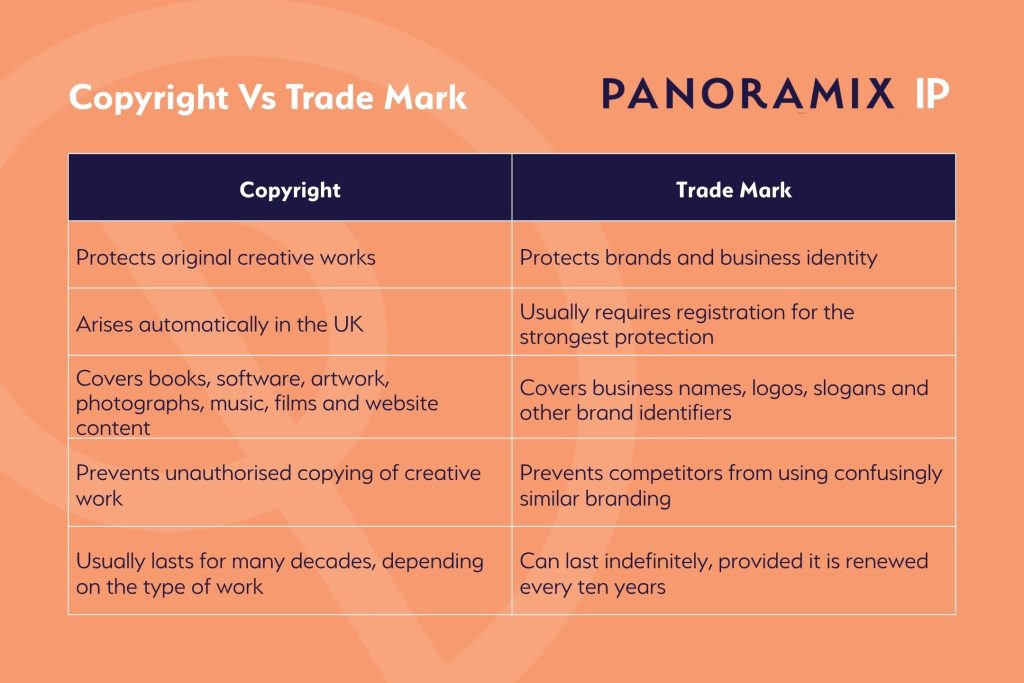
Understanding this distinction is essential, as choosing the wrong type of protection can leave valuable assets exposed. See our useful graphic below to better understand the differences between copyright and trade marks.

Copyright Vs Trade Mark Comparison Table

A common misunderstanding is that copyright protects business names or company names. In reality, names, titles and short phrases are not generally protected by copyright. If your priority is preventing another business from trading under a similar name or using a logo that could confuse customers, registering a trade mark is usually the most effective solution.

There are situations where both rights apply to the same asset. An original logo, for example, may attract copyright because it is an artistic work, while registering that same logo as a trade mark protects the brand it represents. Together, these rights provide broader protection than either could offer on its own.

When Do You Need Copyright?

If your business creates original content, there is a good chance you already own valuable copyright. Every website page you write, photograph you commission, software application you develop or marketing brochure you produce has the potential to become an important business asset. Copyright exists to ensure that other people cannot simply copy that work and benefit from the time, effort and investment that went into creating it.

Businesses regularly rely on copyright to protect a wide variety of creative works, including:

  • Website content and blog articles
  • Product descriptions and marketing materials
  • Software, mobile applications and source code
  • Photographs, illustrations and graphic design
  • Videos, animations and other multimedia content
  • Technical drawings, plans and architectural designs
  • User manuals, guides and instructional materials
  • Original artwork, music and other creative works

For many organisations, these assets form an important part of their competitive advantage, making it essential to understand who owns the copyright and how those rights can be enforced if infringement occurs.

Although copyright arises automatically, ownership is not always as straightforward as people expect. Work created by employees is often owned by the employer, while material produced by freelancers, agencies or external contractors may remain the property of the creator unless ownership has been formally assigned. Taking professional advice and ensuring contracts clearly address intellectual property ownership can help avoid expensive disputes in the future.

Can You Have Both Copyright and a Trade Mark?

Yes, and in many cases having both forms of protection is the most effective way to safeguard your intellectual property.

Consider a business logo. The artwork itself may be protected by copyright because it is an original artistic creation. However, copyright alone is unlikely to stop another business from adopting similar branding if the issue relates to customer confusion rather than copying the artwork itself. Registering the logo as a trade mark provides additional protection by giving the owner exclusive rights to use that logo in connection with the goods or services for which it has been registered.

The same principle applies to many businesses. A software company may own copyright in its source code, documentation and website content while also registering its company name, product names and logo as trade marks. Using copyright alongside trade mark registration creates a more comprehensive intellectual property strategy, protecting both the creative work your business produces and the reputation your brand has built over time.

To better understand whether you need copyright protection or a trade mark (or both), click here to book a 45-minute IP and copyright consultation for free, with one of our copyright attorneys.

How Do I Register Copyright?

One of the questions we’re asked most often is how to register copyright in the UK. The answer is surprisingly simple, because unlike trade marks, patents and registered designs, there is no official copyright register. In most cases, copyright protection arises automatically as soon as an original work is created and recorded in a tangible form, meaning there is no application process and no government register to apply to.

Although registration is not required, keeping clear records of when work was created, who created it and who owns the copyright is still extremely important. Good record keeping can make it much easier to prove ownership if your rights are ever challenged or if you need to take action against somebody who has copied your work without permission.

If you’re unsure whether copyright provides sufficient protection, or you’re wondering whether your business would also benefit from registering a trade mark, professional advice from a copyright solicitor can help you make the right decision from the outset. 

At Panoramix IP, our experienced intellectual property lawyers offer a variety of copyright protection services. Our team advise businesses, entrepreneurs and creators on every aspect of intellectual property, including copyright, trade marks, patents and design rights. We offer free 45-minute IP Clinics, giving you the opportunity to discuss your ideas, understand your options and put the right protection in place before problems arise. Click here to book your free copyright consultation.

What Should You Do If Someone Is Infringing Your Copyright?

If you believe that somebody is infringing your copyright, seeking professional legal advice from one of our copyright infringement lawyers as early as possible can help you protect your rights and avoid taking steps that may weaken your position. 

Copyright infringement occurs when someone copies, reproduces, publishes, distributes or otherwise uses your original work without your permission and without a valid legal defence. Common examples include copying website content, reproducing photographs without consent, using software code unlawfully, republishing blog articles, sharing marketing materials or using creative works for commercial purposes without the copyright owner’s permission.

If you suspect somebody has infringed your copyright, there are several practical steps you should take as soon as possible:

  • Contact an experienced intellectual property lawyer at Panoramix IP to understand your legal rights and the options available.
  • Gather evidence of the infringement, including screenshots, website links and copies of the original work.
  • Keep records showing when the work was created and demonstrating that you own the copyright.
  • Avoid contacting the other party before taking legal advice, particularly if the infringement involves a commercial competitor

Every copyright dispute is different, so the most appropriate course of action will depend on the circumstances. In many cases, matters can be resolved without court proceedings by sending a carefully drafted copyright cease and desist letter, negotiating a licence or settlement, or securing the removal of the infringing content. Where a dispute cannot be resolved amicably, legal action may be necessary to stop the infringement and recover damages.

If somebody has copied your work, don’t assume there’s nothing you can do. Get in touch with an experienced copyright lawyer at Panoramix IP today. Our team will explain your options in plain English and work with you to develop a practical, commercially focused strategy for protecting your intellectual property.

A busy IP lawyers office, with people sat at their desk, and a blurred lady walking past.

Get In Touch

Marketing communications
By clicking submit below, you consent to allow Panoramix Limited to store and process the personal information submitted above to provide you the content requested.