
Trade Marks Archives - Panoramix IP

Trade Mark Clearance Searches: What Should You Check Before Applying for a Trade Mark?

Choosing a name for a new business, product or service can take weeks.

You find the right name. Secure the domain. Develop the logo. Perhaps you have already started designing packaging, building the website or preparing the launch campaign.

Then you discover that somebody else owns an earlier trade mark that could cause a problem.

This is exactly why trade mark clearance should be considered before substantial time and money is invested in a new brand.

A trade mark clearance search can help establish whether your proposed name or logo is likely to encounter existing rights and identify potential issues before you proceed with a trade mark application.

But what should you actually search for, and is checking whether an identical name exists enough?

What is a trade mark clearance search?

A trade mark clearance search investigates existing trade marks and potentially relevant earlier rights before a new trade mark application is filed or a brand is launched.

The objective is not simply to determine whether your exact proposed name has already been registered.

A meaningful search should help assess the wider risk presented by existing marks that may be considered identical or similar and cover relevant goods or services.

This distinction matters.

A business could search for its exact proposed brand name, find nothing identical and assume the name is available, while overlooking a similar earlier trade mark that presents a potential obstacle.

Panoramix IP’s Trade Mark Search Services help businesses investigate existing rights and understand potential risks before committing to an application or brand launch.

Why carry out trade mark clearance before applying?

Registering a trade mark is only one part of launching and protecting a brand.

By the time an application is filed, a business may already have spent substantial amounts on:

  • Naming and brand strategy
  • Logo design
  • Website development
  • Domain names
  • Packaging
  • Signage
  • Marketing materials
  • Product development
  • Advertising and launch campaigns

Discovering a potentially conflicting earlier right at this stage can be expensive.

In some circumstances, the business might need to rethink the brand, amend its application, defend opposition proceedings or negotiate with the owner of an earlier right.

A clearance search cannot guarantee that no dispute will ever arise, but it can provide a much clearer picture of the landscape before significant investment is made.

What should you check before applying for a trade mark?
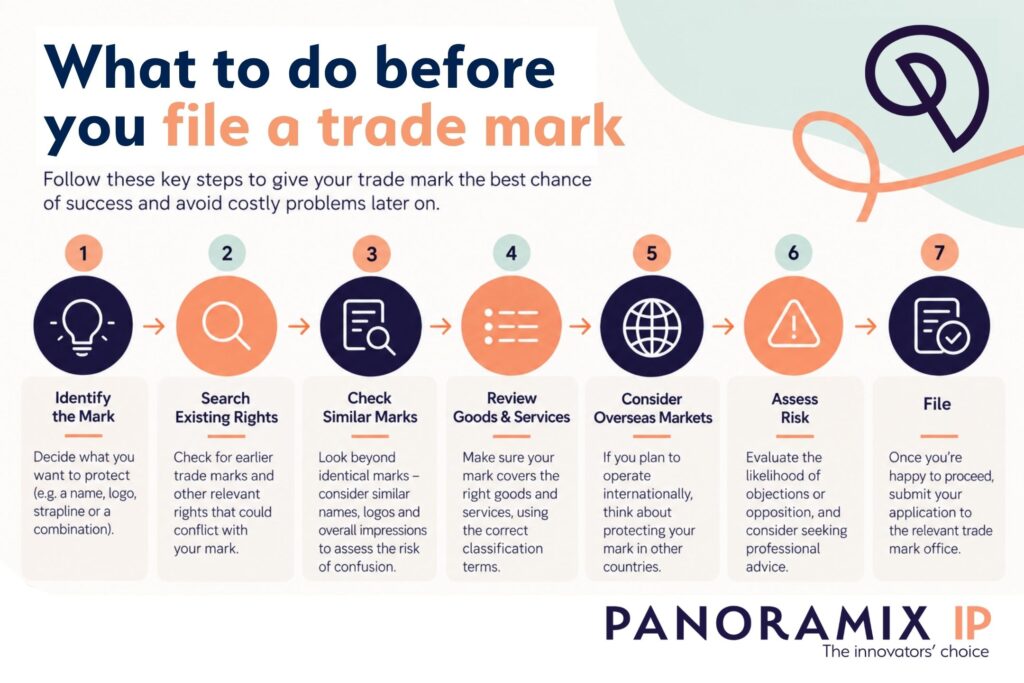
What should you do before you file a trade mark in the uk

1. Search for identical registered trade marks

The obvious starting point is checking whether an identical mark has already been registered or applied for.

This is important, but it should not be the end of the search.

Trade mark conflicts are not limited to two businesses using precisely the same spelling.

2. Search for similar trade marks

A good trade mark search should also consider potentially relevant similar marks.

This might include similarities in:

  • Spelling
  • Pronunciation
  • Appearance
  • Meaning
  • Overall commercial impression

A small spelling change does not necessarily make a proposed brand safe to use or register.

For example, adding a descriptive word, changing one letter or using a phonetic variation may still leave a mark sufficiently close to an earlier right to create difficulties.

This is one reason professional trade mark clearance services go further than simply typing a proposed name into a database.

3. Check the relevant goods and services

Trade marks are registered in relation to specified goods and services.

This means finding the same or a similar name on the register does not automatically tell you whether your proposed application is problematic.

You need to consider what the earlier trade mark actually protects and whether those goods or services overlap with, or are sufficiently similar to, your own.

A business selling software, for example, needs to think carefully about the particular type of software and associated services it intends to provide rather than simply deciding that it belongs in a broad “technology” category.

Getting the specification right at the filing stage is an important part of effective trade mark protection.

4. Consider unregistered rights

The trade mark register is extremely important, but registered trade marks are not necessarily the only rights that need to be considered.

A business may potentially have established rights through use of a brand even where that brand has not been registered as a UK trade mark.

This means a register search should form part of a broader assessment rather than being treated as an absolute guarantee that a name is free to use.

Depending on the circumstances, searches may also consider company names, websites, domain names, marketplaces and general commercial use.

5. Check company names and domain names

Registering a company name at Companies House is not the same as registering a trade mark.

Likewise, owning a domain name does not automatically give you the right to use that name as a trade mark.

However, company and domain searches can still provide useful information when assessing the commercial landscape around a proposed brand.

If another business is already operating under a similar name in a related sector, this may warrant closer investigation even if your initial trade mark register search does not reveal an obvious identical registration.

6. Think beyond the UK

If you intend to trade internationally, a UK-only search may not tell you everything you need to know.

Trade mark rights are territorial.

A brand that appears available in the UK may encounter existing rights when the business expands into Europe, the United States or another important market.

It is therefore worth considering future expansion before committing heavily to a brand.

Where international growth is part of the plan, Panoramix IP can help businesses develop an international IP strategy that considers the territories that matter commercially.

Can I check a trade mark myself?

The UK trade mark register can be searched publicly, so it is certainly possible to carry out an initial search yourself.

This can be useful during the early stages of naming a business or product.

The more difficult question is not necessarily whether a result exists, but what that result means.

Would a similar mark create a meaningful risk? Are the goods and services sufficiently close? Does an earlier registration cover areas relevant to your proposed business? Is there a sensible way to adjust the application?

Professional clearance work combines searching with analysis.

That becomes particularly valuable where the brand is commercially important, significant investment is planned or the search reveals potentially relevant earlier rights.

What happens if you find a similar trade mark?

Finding a similar trade mark does not automatically mean that you must abandon your proposed brand.

The level of risk depends on the particular marks, their goods and services, the territories involved and other relevant circumstances.

Possible next steps might include:

  • Proceeding with the application
  • Refining the goods and services covered
  • Modifying the proposed mark
  • Approaching the owner of an earlier right
  • Exploring a coexistence agreement
  • Choosing an alternative brand
  • Seeking further advice before making a commercial decision

The important point is that these decisions can be made before significant investment is committed, rather than after a dispute arises.

Where a potential conflict has already developed, advice on trade mark disputes and enforcement may also be required.

What happens after a trade mark clearance search?

If the search results are favourable and the risk is considered acceptable, the next stage will usually be preparing and filing the trade mark application.

This includes deciding:

  • Who should own the trade mark
  • Exactly what mark should be protected
  • Which goods and services should be included
  • Which classes are appropriate
  • Which countries require protection

These decisions matter.

A trade mark registration is a business asset, and the application should be structured around how the brand is actually used and how the business expects it to develop.

For founders and growing businesses, considering these issues as part of a broader IP strategy can help avoid having to untangle ownership or protection issues later.

Trade mark clearance is about managing risk before you invest

A new brand can quickly become one of a business’s most valuable assets.

That makes it worth asking the right questions before committing to it.

A trade mark clearance search can identify potential conflicts at an early stage, allowing you to make an informed decision about whether to proceed, adapt your plans or investigate an issue further.

At Panoramix IP, our trade mark attorneys and solicitors provide trade mark search and clearance services alongside filing, prosecution and wider brand protection advice.

Whether you are launching a new business, introducing a product, rebranding or expanding an established brand into new markets, we can help you understand the existing trade mark landscape before you make your next move.

Planning a new brand or trade mark application? Get in touch with Panoramix IP to discuss a trade mark clearance search.

What’s the Difference Between Copyright and a Trade Mark?

From software and website content to logos, photographs and marketing materials, businesses create valuable intellectual property every day. Understanding how copyright differs from a trade mark is essential if you want to make sure those assets are properly protected. 

Although both are forms of intellectual property, they serve very different purposes, and knowing which one applies to your work can help you avoid costly disputes while ensuring your business retains ownership of its most valuable assets.

Many people assume that copyright and trade marks offer the same type of protection, or that simply creating something automatically protects every aspect of it. In reality, the two rights exist for different reasons. Copyright protects original creative works, while trade marks protect the brands that customers recognise and trust. Understanding the distinction is often the first step towards developing an effective intellectual property strategy.

In this article, our international and UK copyright lawyers at Panoramix IP advise on what copyright protection means, when it’s important, and what the difference is between copyright and trade marks.

What Is Copyright?

The definition of copyright is a legal right that protects original creative works from being copied, reproduced or used without the permission of the copyright owner. 

Unlike patents, trade marks and registered designs, copyright arises automatically as soon as an original work is created and recorded in a tangible form. There is no official copyright registration system in the UK, meaning creators do not need to submit an application before their work receives legal protection.

Copyright applies to a wide range of creative works, including books, articles, website content, software, photographs, artwork, films, music, sound recordings, technical drawings and databases. As long as the work is original and meets the legal requirements for copyright protection, the creator will usually own copyright from the moment it is created, although ownership can differ in certain situations, such as where work has been produced by an employee as part of their role or where contractual arrangements state otherwise.

The purpose of copyright is to give creators control over how their work is used. In most cases, the copyright owner has the exclusive right to copy, publish, distribute, licence or adapt their work, preventing others from using it without permission. Copyright can also become a valuable commercial asset, allowing businesses to generate income through licensing agreements or by enforcing their rights against those who copy their work unlawfully.

It is important to remember that copyright protects the expression of an idea rather than the idea itself. For example, copyright can protect the words used in a blog article or the source code behind a software application, but it does not prevent somebody else from creating their own work based on the same concept, provided they do not copy the original expression.

What’s the Difference Between Copyright and a Trade Mark?

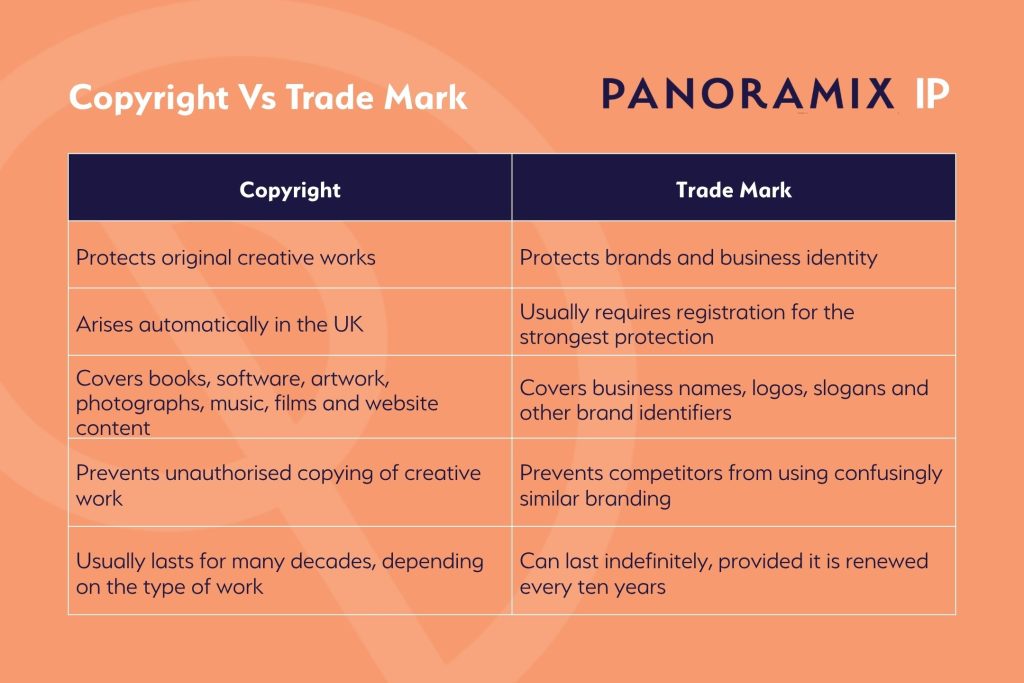
Although copyright and trade marks are both intellectual property rights, they protect completely different aspects of a business. Copyright focuses on original creative works, while a trade mark protects the identity of a business, including the names, logos and branding that customers use to recognise its products or services. 

Understanding this distinction is essential, as choosing the wrong type of protection can leave valuable assets exposed. See our useful graphic below to better understand the differences between copyright and trade marks.

Copyright Vs Trade Mark Comparison Table

A common misunderstanding is that copyright protects business names or company names. In reality, names, titles and short phrases are not generally protected by copyright. If your priority is preventing another business from trading under a similar name or using a logo that could confuse customers, registering a trade mark is usually the most effective solution.

There are situations where both rights apply to the same asset. An original logo, for example, may attract copyright because it is an artistic work, while registering that same logo as a trade mark protects the brand it represents. Together, these rights provide broader protection than either could offer on its own.

When Do You Need Copyright?

If your business creates original content, there is a good chance you already own valuable copyright. Every website page you write, photograph you commission, software application you develop or marketing brochure you produce has the potential to become an important business asset. Copyright exists to ensure that other people cannot simply copy that work and benefit from the time, effort and investment that went into creating it.

Businesses regularly rely on copyright to protect a wide variety of creative works, including:

  • Website content and blog articles
  • Product descriptions and marketing materials
  • Software, mobile applications and source code
  • Photographs, illustrations and graphic design
  • Videos, animations and other multimedia content
  • Technical drawings, plans and architectural designs
  • User manuals, guides and instructional materials
  • Original artwork, music and other creative works

For many organisations, these assets form an important part of their competitive advantage, making it essential to understand who owns the copyright and how those rights can be enforced if infringement occurs.

Although copyright arises automatically, ownership is not always as straightforward as people expect. Work created by employees is often owned by the employer, while material produced by freelancers, agencies or external contractors may remain the property of the creator unless ownership has been formally assigned. Taking professional advice and ensuring contracts clearly address intellectual property ownership can help avoid expensive disputes in the future.

Can You Have Both Copyright and a Trade Mark?

Yes, and in many cases having both forms of protection is the most effective way to safeguard your intellectual property.

Consider a business logo. The artwork itself may be protected by copyright because it is an original artistic creation. However, copyright alone is unlikely to stop another business from adopting similar branding if the issue relates to customer confusion rather than copying the artwork itself. Registering the logo as a trade mark provides additional protection by giving the owner exclusive rights to use that logo in connection with the goods or services for which it has been registered.

The same principle applies to many businesses. A software company may own copyright in its source code, documentation and website content while also registering its company name, product names and logo as trade marks. Using copyright alongside trade mark registration creates a more comprehensive intellectual property strategy, protecting both the creative work your business produces and the reputation your brand has built over time.

To better understand whether you need copyright protection or a trade mark (or both), click here to book a 45-minute IP and copyright consultation for free, with one of our copyright attorneys.

How Do I Register Copyright?

One of the questions we’re asked most often is how to register copyright in the UK. The answer is surprisingly simple, because unlike trade marks, patents and registered designs, there is no official copyright register. In most cases, copyright protection arises automatically as soon as an original work is created and recorded in a tangible form, meaning there is no application process and no government register to apply to.

Although registration is not required, keeping clear records of when work was created, who created it and who owns the copyright is still extremely important. Good record keeping can make it much easier to prove ownership if your rights are ever challenged or if you need to take action against somebody who has copied your work without permission.

If you’re unsure whether copyright provides sufficient protection, or you’re wondering whether your business would also benefit from registering a trade mark, professional advice from a copyright solicitor can help you make the right decision from the outset. 

At Panoramix IP, our experienced intellectual property lawyers offer a variety of copyright protection services. Our team advise businesses, entrepreneurs and creators on every aspect of intellectual property, including copyright, trade marks, patents and design rights. We offer free 45-minute IP Clinics, giving you the opportunity to discuss your ideas, understand your options and put the right protection in place before problems arise. Click here to book your free copyright consultation.

What Should You Do If Someone Is Infringing Your Copyright?

If you believe that somebody is infringing your copyright, seeking professional legal advice from one of our copyright infringement lawyers as early as possible can help you protect your rights and avoid taking steps that may weaken your position. 

Copyright infringement occurs when someone copies, reproduces, publishes, distributes or otherwise uses your original work without your permission and without a valid legal defence. Common examples include copying website content, reproducing photographs without consent, using software code unlawfully, republishing blog articles, sharing marketing materials or using creative works for commercial purposes without the copyright owner’s permission.

If you suspect somebody has infringed your copyright, there are several practical steps you should take as soon as possible:

  • Contact an experienced intellectual property lawyer at Panoramix IP to understand your legal rights and the options available.
  • Gather evidence of the infringement, including screenshots, website links and copies of the original work.
  • Keep records showing when the work was created and demonstrating that you own the copyright.
  • Avoid contacting the other party before taking legal advice, particularly if the infringement involves a commercial competitor

Every copyright dispute is different, so the most appropriate course of action will depend on the circumstances. In many cases, matters can be resolved without court proceedings by sending a carefully drafted copyright cease and desist letter, negotiating a licence or settlement, or securing the removal of the infringing content. Where a dispute cannot be resolved amicably, legal action may be necessary to stop the infringement and recover damages.

If somebody has copied your work, don’t assume there’s nothing you can do. Get in touch with an experienced copyright lawyer at Panoramix IP today. Our team will explain your options in plain English and work with you to develop a practical, commercially focused strategy for protecting your intellectual property.

Someone Is Using My Trade Mark In Their Website Domain Name: What Can I Do?

Discovering that someone else has registered a domain name using your registered trade mark can be frustrating, particularly if they’re using it to sell similar products, divert customers or simply prevent you from using your own brand online.

While owning a registered trade mark does not automatically give you ownership of every matching domain name, it can provide you with strong legal grounds to challenge the registration or use of that domain in certain circumstances.

In this guide, our Nottinghamshire IP Lawyers will explain your rights, the options available to you, and how to resolve a domain name dispute.


Does Owning a Trade Mark Automatically Give You the Domain Name?

No. Registering a trade mark does not automatically give you ownership of the matching domain name.

A trade mark and a domain name are two separate rights that must each be obtained independently. Registering your business name as a trade mark does not reserve the corresponding website address, and purchasing a domain name does not give you ownership of the trade mark.

For example, you could successfully register the trade mark Bills Coffee, only to discover that billscoffee.co.uk or billscoffee.com has already been registered by someone else. Equally, someone may own a domain name without having any registered trade mark rights.
This is why it’s important to secure both your trade mark and your preferred domain name as early as possible when launching a new brand.


When Could a Domain Name Infringe Your Trade Mark?

If someone else owns the domain name that matches your registered trade mark, this does not automatically mean that they are committing infringement.

However, you may have grounds to take action if the domain:

  • Is identical or confusingly similar to your registered trade mark.
  • Is being used in connection with similar goods or services.
  • Is likely to mislead customers into believing there is an association with your business.
  • Takes unfair advantage of your brand’s reputation.
  • Damages the distinctive character or reputation of your trade mark.

For example, if your registered trade mark is Bills Coffee, and someone registers billscoffee.co.uk to sell competing coffee products, this could potentially infringe your trade mark rights.

An experienced domain name IP lawyer can assess your position, advise whether you have a potential claim, and advise on the most appropriate course of action. We’d recommend booking a free 45-minute consultation with one of our specialists at Panoramix IP, who can support with your next steps.


What If Someone’s Using My Trade Mark In a Domain That Isn’t In Use?

Sometimes you’ll discover that the domain simply displays a holding page, advertisements or a message stating that it is for sale.

Even if the domain is inactive, you may still have options.

In some cases, registering a domain primarily to prevent the legitimate trade mark owner from using it, or to sell it back for profit, may be considered evidence of bad faith.

Inactive domains can therefore still become the subject of a successful domain name dispute, depending on the circumstances.


What Is Cybersquatting?

Cybersquatting is the practice of registering a domain name that incorporates another person’s trade mark or brand with the intention of benefiting from their reputation.

Common examples include:

  • Registering a well-known business name before the genuine owner can.
  • Purchasing domains that closely resemble established brands.
  • Registering common misspellings of popular websites (known as typosquatting).
  • Attempting to sell the domain back to the trade mark owner for an inflated price.
  • Using the domain to divert customers to a competing business.

Cybersquatting is a common cause of domain name disputes, and there are established procedures available to challenge these registrations.

If you believe someone is cybersquatting on your brand or domain name, our experienced domain name lawyers are here to help. Get in touch with a member of our team today!


How Can You Recover a Domain Name?

If someone has registered a domain name that infringes your trade mark rights or has been registered in bad faith, you may be able to challenge the registration and recover the domain. The most appropriate course of action will depend on factors such as the domain extension, the circumstances of the registration and the evidence available.

For .uk and .co.uk domain names, disputes can often be resolved through Nominet’s Dispute Resolution Service (DRS), while disputes involving .com, .net, .org and many other international domain extensions are typically handled under the Uniform Domain Name Dispute Resolution Policy (UDRP).

Navigating these procedures can be complex, particularly where trade mark rights, allegations of bad faith or competing claims to a domain name are involved. Seeking specialist legal advice at an early stage can significantly improve your chances of reaching a successful outcome.

At Panoramix IP, our experienced domain name dispute lawyers regularly advise businesses on recovering domain names, defending against disputes and protecting valuable brands online. We’ll assess the strength of your case, explain the options available and guide you through the most appropriate dispute resolution process, helping you protect your intellectual property with confidence.


What Evidence Can Help With A Domain Name Dispute?

When disputing a domain name, the stronger your evidence, the stronger your position.

Useful evidence may include:

  • Your registered trade mark certificate.
  • Evidence showing when you first started using your brand.
  • Screenshots of the website using the disputed domain.
  • Examples of customer confusion.
  • Marketing materials demonstrating your reputation.
  • Correspondence with the domain owner.
  • Evidence suggesting the domain was registered in bad faith.

Collecting evidence early can help support any negotiations or formal dispute proceedings. At Panoramix IP, we support domain name dispute claimants to collect the necessary evidence for a successful claim.


How to Protect Your Brand Online

While domain name disputes cannot always be avoided, there are several steps you can take to reduce the risk:

  • Register your trade mark as early as possible (We now offer quick and easy online filing service for UK and US trade marks!)
  • Secure the main domain extensions for your business, including .co.uk, .uk and .com where appropriate.
  • Register common spelling variations of your brand.
  • Monitor new domain registrations that may affect your business.
  • Consider international trade mark protection if you operate overseas or plan to expand.

Taking a proactive approach to brand protection is often far less costly than resolving a dispute later.


Get Help with a Domain Name Dispute

If someone has registered or is using a domain name that incorporates your trade mark, don’t wait to take action. We can help!

At Panoramix IP, our experienced domain name dispute lawyers advise businesses of all sizes on trade mark infringement, domain name disputes and brand protection strategies. We can assess your legal position, explain the options available and help you pursue the most effective resolution for your circumstances.

If you’re concerned that someone is using your trade mark as their domain name, get in touch with our team today to discuss your options.

UKIPO Official Fees to Rise in April 2026 — What It Means for Your IP Strategy

The UK Intellectual Property Office (UKIPO) has announced a significant update to its official fee structure, with fees for patents, trade marks and designs set to increase by an average of around 25% from 1 April 2026, subject to parliamentary approval.

As the first major fee rise in many years — with trade mark fees unchanged since 1998, design fees since 2016 and patent fees since 2018 — these changes will directly affect how businesses plan, prioritise and budget for intellectual property protection.

For many organisations, the increases highlight the growing importance of a well-considered IP strategy, where decisions about what to protect, when to file and how to manage portfolios are aligned closely with commercial goals.

Person using a calculator and sitting at a desk with a paper document.

Why the Fee Increases Are Happening

The UKIPO has absorbed rising operational costs for years by improving internal efficiencies and investing in digital services. However, with inflation rising by approximately 32% since 2016, the Office has concluded that a fee reset is necessary to maintain high-quality services.

What Will Change — Key Examples

Though the full fee schedule will be published in detail by the UKIPO early in 2026, some notable changes already highlighted include:

Patent fees:

  • Patent online search fee rising from £150 to £200
  • Substantive examination online fees increasing from £100 to £130
  • Significant increases in renewal fees across patent terms, especially in later years

Trade Marks:

  • Online application fee increasing from £170 to £205
  • Renewal fee rising from £200 to £245
  • Fees for oppositions and invalidations increasing by around 20–25%

Registered Designs:

  • Simple online design applications rising from around £50 to £60
  • Multi-design applications similarly increasing across the bands

While these changes might initially seem steep, even the revised UKIPO fees are still competitive with many other global offices — meaning the UK remains an attractive jurisdiction for securing IP protection.

Intellectual property words with a hand pointing towards a search icon.

Why Acting Early Can Reduce Costs and Strengthen Your IP Strategy

With the current fee structure remaining in place until 31 March 2026, innovators and rights holders have a valuable opportunity to file applications or manage renewals in advance, securing lower official fees.

Acting early not only helps control costs but also allows businesses to take a more proactive IP strategy, aligning filing decisions with commercial priorities before the higher fees come into effect. For example:

  • Trade mark and design renewals (which can be filed up to 6 months before expiry) may be submitted at current rates if filed by 31 March 2026.
  • Patent renewals (available up to 3 months in advance) may similarly be accelerated where appropriate.

Early planning and accurate forecasting of your IP filing calendar can substantially reduce official costs — and it’s one area where professional guidance makes a real difference.

Why Professional Representation Still Matters — Especially with Fee Changes

With higher official fees on the horizon, many businesses will naturally seek ways to manage costs, but attempting to navigate filings and deadlines alone can be risky. Here’s how Panoramix adds value in this evolving landscape:

1. Strategic Cost-Optimised Filing and Renewal Planning

Panoramix helps clients identify the best timing for filing or renewing rights to avoid unnecessary increases. This is especially important when there are opportunities to file before fee hikes take effect. Careful portfolio management and early renewal assessment can save significant sums in official fees.

2. Expertise in Complex Filings Reduces Errors and Delays

Official fee structures often come with procedural conditions that, if overlooked, can lead to additional costs or lost rights. Panoramix’s experienced solicitors and attorneys ensure applications are correct, complete, and optimised to avoid rejections, extensions, or repeat filings, which can be costly both in fees and time.

3. Tailored Advice for International and Multi-Jurisdiction Strategies

Many businesses use UK filings strategically. For example, as priority filings under the Paris Convention before global expansion. Increasing UKIPO fees underscores the need for holistic cost planning across jurisdictions. Panoramix draws on cross-jurisdictional expertise to advise on the most cost-efficient global pathways.

4. Proactive IP Portfolio Audits and Budget Forecasting

With fee increases planned, rights holders benefit from a forward-looking audit of their IP portfolios. Panoramix offers proactive reviews to help you budget ahead, plan renewals and assess the ongoing value of each right. This ensures you invest in the rights that matter most.

5. Dedicated Support Through System Modernisation

As the UKIPO continues to enhance its systems and processes — partly funded by the forthcoming fee increases — Panoramix ensures clients are supported through any procedural changes or new digital requirements that may accompany these updates.

Final word

The UKIPO fee increases taking effect in April 2026 present a clear signal: intellectual property protection in the UK remains a strategic priority, but costs are changing. By planning ahead and partnering with experienced professionals like those at Panoramix, your business can navigate these changes efficiently, protect vital assets, and potentially mitigate the impact of higher official fees.


Now is the time to review your IP strategy — before fees go up. Panoramix is here to help you make the most of every opportunity. Contact us today for tailored advice on filing and renewal timing, cost-effective portfolio management, and building an IP strategy that supports your long-term commercial goals.

Trademark Infringements Highlight the Need for Expert Legal Support

Recent law enforcement action in Lincolnshire highlights the risks that businesses and individuals face when intellectual property rights are violated. In a police operation aimed at stopping crime in cash-heavy businesses, police visited 37 locations across the county. They made several arrests related to counterfeit goods and trademark violations under UK law.

As part of Operation Machinize, a project by the National Crime Agency, enforcement teams found thousands of illicit products, including counterfeit cigarettes and mobile phones. This led to the seizure of illegal goods and cash linked to criminal activity. Four people were arrested for possession of cigarettes infringing trademarks contrary to Section 92 of the Trade Marks Act 1994 and investigations are still ongoing.

This enforcement action highlights two critical truths for businesses operating in the UK:

1. Trademark infringement is taken seriously by law enforcement, with real criminal consequences.

2. Counterfeit goods in legitimate-looking supply chains can expose businesses to legal action, civil liability, and reputational harm.

Person using laptop and registered trademark logo in foreground

Why Trademark Protection Matters

Trademarks are more than just logos or names, they are legal rights that protect brands, assure consumers of product authenticity, and support fair competition in the marketplace. When trademarks are ignored or abused, the consequences ripple across the economy: consumers risk unsafe products, rights holders face lost revenue and brand dilution, and communities may be drawn into criminal activity.

In complex enforcement situations like the recent raids in Lincolnshire, even small businesses can face legal challenges if:

  • They unknowingly source or distribute counterfeit goods;
  • Their branding or product names risk infringing on existing trademark rights;
  • They face allegations of unauthorised use of intellectual property.

How Panoramix Helps Protect Your Trademark and Intellectual Property Rights

At Panoramix IP, we specialise in providing comprehensive trademark and intellectual property law services to help businesses of all sizes protect their brands and navigate legal risks effectively. Our experienced team can support you with:

Trademark Strategy & Registration

Securing robust rights through UK and international trademark registration, so your brand is protected before issues arise.

Trademark Infringement Monitoring & Enforcement

Proactive monitoring of potential trademark infringement activity and swift legal action against unauthorised use of your marks.

Due Diligence & IP Risk Assessment

Completing an IP audit to identify supply chains and product portfolios, and mitigate exposure to counterfeit risk and enforcement action.

Legal Defence for IP Disputes

Expert representation and advice if you ever face allegations of infringement or related intellectual property disputes.

Educating Businesses on Best Practice

From filing trademarks correctly to building compliant IP strategies, we help clients reduce legal vulnerabilities through our full suite of IP services.

Lawyer sitting at desk and writing on paper.

From Trademark Infringement Risk to Brand Protection

The Lincolnshire operation serves as a potent reminder: intellectual property rights are enforced at all levels, and businesses must be vigilant to safeguard their own rights and ensure compliance. Whether you’re launching a new brand, expanding internationally, or defending against infringement claims, getting expert legal support early can make all the difference.


If you want to secure your brand, protect your market position, and stay ahead of enforcement risks, the Panoramix IP team is here to help. Contact us today for tailored advice on trademark protection and enforcement.

What is a trade mark?

When building a brand, protecting your intellectual property is crucial. One of the most effective ways to do this is through trade marks. But what exactly can you trade mark in the UK? Here’s a straightforward guide to help you understand what qualifies—and what doesn’t.
A trade mark is a sign that distinguishes your goods or services from those of other businesses. It can be vital for brand recognition, customer trust, and legal protection.

What Can Be Trade Marked?

In the UK, you can trade mark any sign that can be represented clearly and precisely, provided it is distinctive and not descriptive of the goods or services. Common examples include:
  • Words: Brand names, company names, product names, slogans.
  • Logos: Graphic symbols, stylised words, emblems.
  • Shapes: Distinctive product shapes or packaging (think of the Coca-Cola bottle).
  • Colours: Specific colours or colour combinations (if they are distinctive for your brand).
  • Sounds: Unique jingles or musical notes (e.g., Intel’s chime).
  • Combinations: Any combination of the above, such as a logo with a slogan.

What Cannot Be Trade Marked?

Certain signs are excluded from trade mark protection in the UK, including:
  • Generic or descriptive terms (e.g., “Fresh Bread” for a bakery)
  • Marks that are misleading, offensive, or contrary to public policy
  • Common surnames or geographical locations (unless they have acquired distinctiveness)
  • Flags, emblems, or hallmarks protected by law
  • Shapes that result from the nature of the goods themselves

Key Considerations

  • Distinctiveness: Your mark must be unique enough to identify your business as the source of goods or services.
  • Non-Descriptive: Avoid marks that simply describe what you offer.
  • Use in Commerce: You must be using, or intend to use, the mark in connection with your goods or services.

Why Register a Trade Mark?

Registering your trade mark gives you exclusive rights to use it in the UK for the goods or services specified. This means you can:
  • Prevent others from using a similar mark
  • Build brand value and recognition
  • License or sell your trade mark as a business asset
  • Take legal action against infringement

How Panoramix IP Can Help

Navigating trade mark registration can be complex. At Panoramix IP, we handle every aspect—from initial searches and application drafting to portfolio management and enforcement. If you’re unsure whether your brand element is eligible for trade mark protection, we’re here to advise.

Ready to protect your brand?
Contact Panoramix IP for expert trade mark advice and a straightforward registration process.

Should I trade mark my business name?

When launching a business, choosing the right name is a milestone moment. But once you’ve settled on that perfect name, a crucial question follows: should I trade mark my business name?
As an IP professional, I see this question come up almost daily. Here’s a practical look at why trade mark registration matters, the risks of skipping it, and what steps to consider.

What’s the Difference?

First, let’s clear up a common misconception: registering your business with Companies House or HMRC does not give you trade mark rights. Company registration simply means you’re legally allowed to operate under that name. It doesn’t stop someone else from using (or even trade marking) a similar name for their products or services.

Why Register as a Trade Mark?

1. Exclusive Rights
A registered trade mark gives you the exclusive right to use your business name for the goods and services it covers. This means you can stop others from using a confusingly similar name in your sector.
2. Stronger Legal Protection
Trade mark registration makes it much easier (and more cost-effective) to enforce your rights if someone tries to copy or piggyback on your brand.
3. Business Value
A registered trade mark is an asset. It can add value to your business, help attract investment, and make expansion or franchising simpler.
4. Peace of Mind
Knowing your brand is protected lets you focus on growth, not legal headaches.

What Happens If You Don’t Register?

  • You risk rebranding if someone else registers a similar name first.
  • You may have limited legal options if another business uses your name or a close variant.
  • You could lose out on building a unique, recognisable brand identity.

What Should You Consider?

  • Check availability: Is your name unique in your sector and region?
  • Think long-term: Will your business expand into new products, services, or countries?
  • Budget for protection: Trade mark registration is an investment, not just an expense.

Bottom Line

Registering your business name as a trade mark isn’t just for big brands. It’s a practical step for any company serious about protecting its reputation and future growth.
If you’re unsure where to start, consider seeking advice from an IP professional. The right guidance now can save you time, money, and stress down the line.

Have questions about trade marks or protecting your brand? Feel free to contact us – happy to help demystify the process.

How much does it cost to oppose a trade mark application in the UK

If you’ve discovered a trade mark application that could threaten your brand or business, you might be considering a formal opposition. But how much does it actually cost to oppose a trade mark application in the UK? Here’s a clear breakdown of the process, key costs, and what to expect.

1. Official Fees

The UK Intellectual Property Office (UK IPO) charges an official fee to file a trade mark opposition. As of July 2025, the standard fees are:
  • £100 for opposing under section 5(1) and/or 5(2) of the Trade Marks Act 1994
  • £200 for opposing under any other grounds

2. Professional Fees

While it’s possible to oppose a trade mark yourself, most businesses choose to instruct an IP professional to maximise their chances of success. Professional fees can vary depending on the complexity of the case, the evidence required, and whether the matter is settled early or proceeds to a full hearing.
At Panoramix IP, our typical cost structure for a straightforward opposition is:
  • Initial assessment and filing: £500–£1,000 + VAT
  • Preparing evidence and submissions: £1,000–£2,500 + VAT (if required)
  • Attending a hearing (if necessary): £500–£1,500 + VAT
Total estimated cost:
For most standard cases, expect an overall investment of £700–£5,000 (including official fees and professional support). Complex or heavily contested cases may cost more.

3. Other Potential Costs

  • Settlement/Negotiation: Many oppositions settle before reaching a hearing, which can reduce costs.
  • Adverse Costs: If you lose, you may be ordered to pay a contribution towards the other party’s costs (usually a capped, modest amount).
  • Additional Evidence: If substantial evidence or expert reports are needed, this can increase the total cost.

4. Is It Worth Opposing?

Opposing a trade mark is an investment in protecting your brand. The cost of not acting, such as confusion in the marketplace or loss of rights, can be far greater. With a success rate of around 85% in our recent opposition and cancellation cases, Panoramix IP can guide you through the process and help you assess your options.

5. Next Steps

If you’re considering an opposition, early action is essential. The opposition window is just two months from publication (extendable to three months). Our team can review your situation, provide a fixed-fee quote, and handle the process from start to finish.

Need advice or a cost estimate?
Contact Panoramix IP for a confidential, no-obligation discussion about your trade mark opposition options.


Trade Mark Protection Matters for Football Clubs: How Lincoln City FC Stays Ahead of the Competition

Panoramix IP and LCFC: A Local Partnership with Global Potential

As proud sponsors of Lincoln City Football Club for the 2025/2026 season, we are delighted to support our local team both on and off the pitch. While our banner will be proudly displayed at all home games at the LNER Stadium next season, our partnership runs deeper than a few pitch-side LED displays.

During our initial research on choosing a local sponsorship partner, we discovered that the trade mark for the club’s iconic Imp logo did not yet have a registered trade mark. As part of our commitment to safeguarding brand identity and supporting our sponsorship partner, we were honoured to assist LCFC in registering their UK Trade Mark.

More than just a local business looking to support a Lincoln-based institution, this highlights the growing need for football clubs across the UK, from the Premier League to grassroots organisations, to recognise intellectual property protection as an essential pillar of sustainable growth, commercial success and protection for fans.


Why Must Football Clubs Protect Their Brand Assets?

Firstly, What is a Trade Mark?

For those new to intellectual property assets, a trade mark is a legally registered symbol, word, or phrase that is used to represent a business or organisation. In football, this often includes club logos, nicknames, icons and slogans. These identifiers are crucial components of a club’s brand and identity. For Lincoln City Football Club, the Imp logo is more than just an emblem. It’s a symbol of heritage, pride, and community, an instantly recognisable badge of honour for fans and players alike going back generations.

Lincoln City Football Club has wisely chosen to invest in protecting this logo to secure its future use.


The Risks of Not Registering

Without trade mark registration, clubs leave themselves vulnerable to imitation, unauthorised merchandising, and brand dilution. This can lead to reputational damage, lost revenue, and legal disputes that could easily be avoided, all of which could put clubs at risk.

With increased exposure through broadcast deals, social media, and international fan bases, even smaller clubs are at risk of their identity being copied or misused. Trade mark registration provides legal recourse and deterrent power to protect against such misuse.

How Trade Mark Protection Supports Business Growth

Creating New Revenue Streams

Registered trade marks open doors to licensing and merchandising opportunities. Clubs can grant permission to trusted manufacturers to use their logos on merchandise, ensuring brand consistency while generating revenue for the club. For LCFC, the Imp logo now has the legal foundation to be part of commercial products that support the club financially, especially when used on next season’s new kit design, or any products sold by LCFC, official distributors or licensees with the rights to sell products with the club Imp logo on.

Building Commercial Partnerships

In the modern sports industry, commercial partnerships rely heavily on brand equity. When clubs protect their intellectual property, they become more attractive to sponsors and investors who value brand consistency and legal clarity. Our decision to sponsor LCFC was bolstered by the club’s willingness to take its brand protection seriously, and through a shared understanding of the importance of brand protection through registered trade marks.

International Expansion

We know that football is a sport played, enjoyed and supported globally. Whether clubs are playing international friendlies, selling kits abroad, or engaging with fans online, a registered trade mark, when registered in the appropriate countries and jurisdictions, ensures that the brand remains protected across borders. This is particularly important for clubs like LCFC, which is poised for further growth beyond local boundaries, especially with the introduction of club initiatives like the innovation lab, which is generating domestic and international attention from strategic partners.

Why This Matters to Imps and to all fans of the beautiful game.

Preserving Heritage and Identity

To football fans, like the Imps, a club icon is not just a logo; it’s part of an iconic tradition, a cultural symbol, and a source of lifelong pride (depending on the result). Trade mark protection ensures that club insignia are preserved and safeguarded from misuse or distortion.

When clubs take action to protect their identity, they are also protecting the emotional investments of their supporters. Knowing that the club is actively working to defend its image fosters trust and loyalty within the fan base.

Ensuring Authentic Merchandise

Supporters want to wear their club’s badge with pride, knowing that every purchase supports the team and, with hope, increases their chances of going up next season. Trade mark protection allows clubs to control the production and distribution of official merchandise, ensuring high quality and financial return.

The Panoramix IP Approach to Supporting Football Brands

As an intellectual property law firm with the ability to file directly in the UK, EU, and US, Panoramix IP brings international expertise with local dedication. Our team of dual-qualified solicitors and attorneys work hand-in-hand with clubs to:

  • Audit current brand assets
  • Register trade marks nationally and internationally
  • Monitor and enforce against unauthorised use
  • Advise on licensing and sponsorship agreements

The work we’ve done with Lincoln City Football Club is a shining example of how timely IP protection can add value and security to a club’s operations.

A Call to Action for All Football Clubs

Whether you’re operating in the Premier League or the National League, intellectual property protection should not be an afterthought. It should be integrated into your club’s commercial, legal, and fan engagement and retention strategy from the outset.

Panoramix IP is here to help football clubs across the UK and beyond take charge of their brand identity. If you’re unsure whether your club’s trade marks are up to date or if you have unregistered brand assets in circulation, get in touch with our team for an initial consultation.

Let Lincoln City Football Club’s proactive approach be a model for others. Because protecting your club means protecting your legacy.

A busy IP lawyers office, with people sat at their desk, and a blurred lady walking past.

Get In Touch

Marketing communications
By clicking submit below, you consent to allow Panoramix Limited to store and process the personal information submitted above to provide you the content requested.